Home › Guides › Portable classrooms in DFW
School buildings guide
Portable classrooms in Dallas-Fort Worth: a 2026 guide for schools
How DFW districts, charter schools and private schools plan portable classrooms: lease vs. buy, sizes, what drives cost, Texas permits and accessibility rules, and a realistic timeline for an August opening.
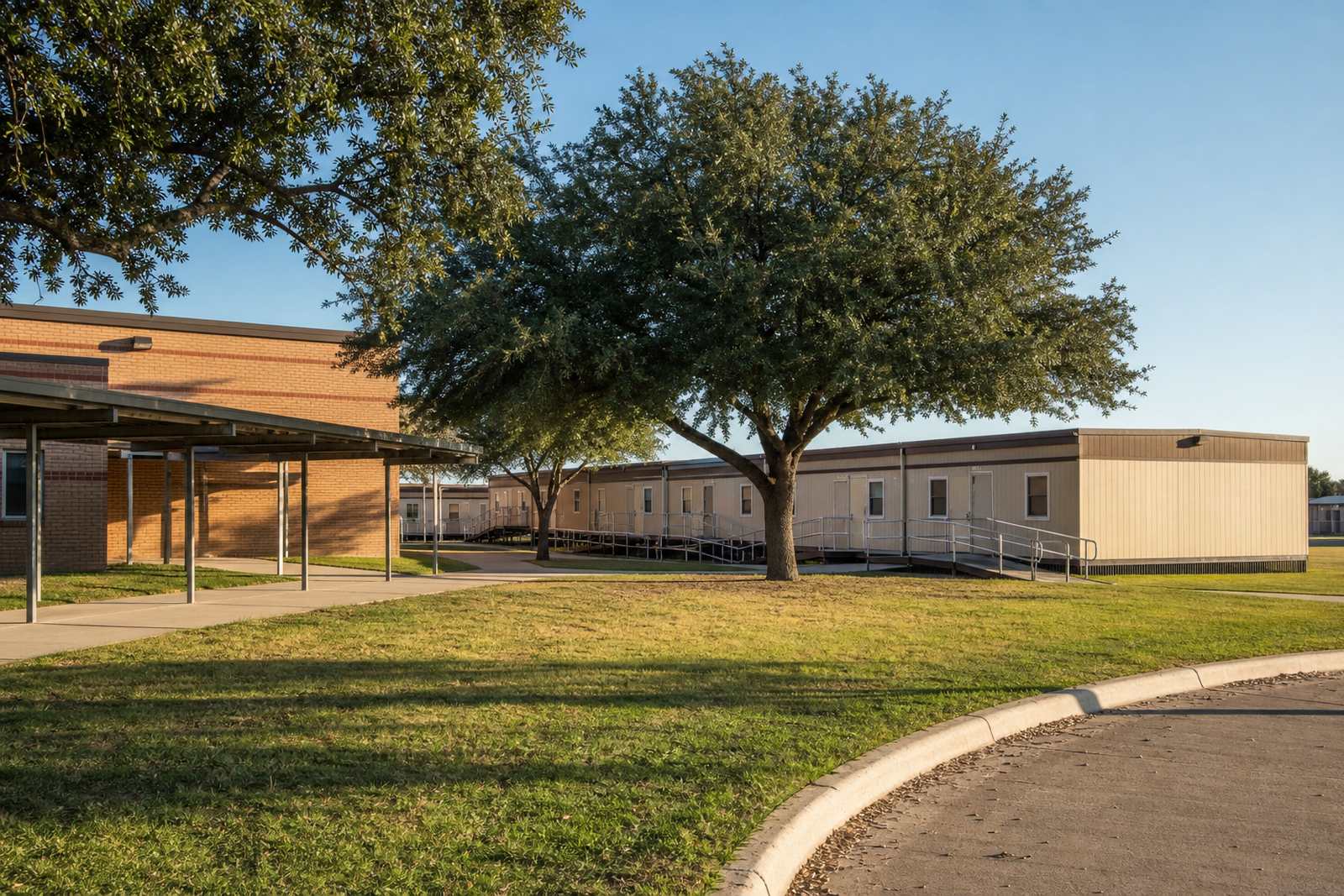
Portable classrooms in Dallas-Fort Worth are relocatable, factory-built classroom buildings that schools lease or buy to add capacity quickly: for enrollment growth, renovation swing space, special programs or a new charter campus. In Texas they are built to state code under the industrialized building program, set on a prepared pad on campus, connected to power (and sometimes water and sewer), and fitted with ramps, steps and fire alarm tie-ins before students move in.
Quick answer: Most DFW schools lease portable classrooms when the need is a few years or less (growth before a new campus opens, or swing space during a bond project) and buy when the need is long-term or the building will move between campuses many times. A standard single classroom is roughly 24×32 to 24×40 feet. Cost depends on new vs. used, size, restrooms, site work, delivery distance and term. For a fall opening, start planning in winter or early spring: summer is the busiest install season in Texas.
This guide is written for superintendents, facilities directors, business managers, charter operators and private school boards across North Texas. If you already know what you need, you can request a free quote or see our portable classrooms page.
Why DFW schools rely on portable classrooms
The Dallas-Fort Worth area has added new neighborhoods at a pace few metros match. Fast-growing suburbs in Collin, Denton, Tarrant, Ellis, Kaufman and Rockwall counties, places like Prosper, Celina, Princeton, Forney and Little Elm, can see new subdivisions fill with families before a new school can be designed, funded by a bond election and built.
Portable classrooms fill that gap. They let a district:
- Absorb enrollment growth at an existing campus until a new school opens.
- Keep students on campus during renovations, instead of busing them to another building.
- Launch programs quickly: pre-K expansion, special education rooms, testing rooms, career and technical education labs.
- Open or grow a charter or private campus without waiting for permanent construction financing.
- Respond to emergencies after storm, fire or flood damage to a permanent building.
Older, landlocked districts use them too. In established cities like Dallas, Fort Worth, Garland and Mesquite, the most common use is swing space during campus rebuilds and additions.
Lease or buy? How to decide
The single most important question is how long you need the space. The second is whether it stays in one place.
| Lease | Buy | |
|---|---|---|
| Typical need | 1–5 years: growth until a new school opens, renovation swing space | Long-term or permanent; frequent moves between campuses |
| Budget | Monthly payments from operating funds; lower up-front cost | Capital purchase (often bond or capital funds) |
| Delivery & return | Delivery, setup and end-of-term removal are part of the deal (confirm in writing) | You own the building; relocation is a separate cost |
| Customization | Fleet floor plans with add-ons | Full choice of layout, finishes and systems |
| Resale | None | Can be resold or reused at the end of the need |
Many districts do both: they own a base fleet of portables that move from campus to campus as enrollment shifts, and lease additional units for short-term spikes or renovation projects. Charter and private schools often start with a lease (sometimes with a lease-to-own option where available) and buy once enrollment and financing stabilize.
Tip: Compare the total cost over your real timeline. A lease with delivery, setup and return included can look very different from a purchase once you add site work, relocation and eventual removal. Ask for both options on the same quote.
Common sizes and configurations
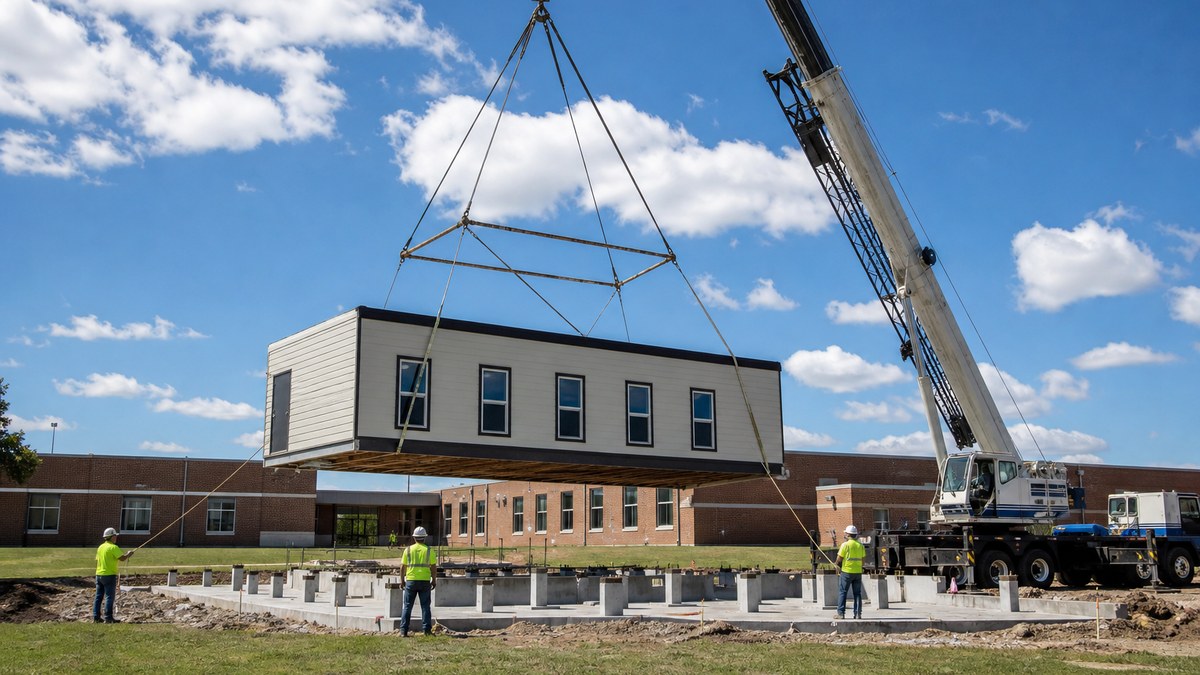
Portable classrooms are built in sections (often called floors or modules) that are trucked to campus and joined on site. Exact dimensions vary by manufacturer, but these are the common configurations in Texas:
| Configuration | Typical size | Common use |
|---|---|---|
| Single classroom | 24×32 to 24×40 ft (about 770–960 sq ft) | One standard K–12 classroom |
| Classroom with restroom | 24×40 ft and up | Pre-K, kindergarten, special education |
| Double classroom ("duplex") | 24×64 ft or 48×40 ft | Two classrooms sharing one building and ramp |
| Multi-classroom building | 4–12+ rooms, often with interior corridor | Grade-level wings, charter campuses, swing space |
| Two-story | Stacked classrooms with stairs | More capacity on tight urban campuses |
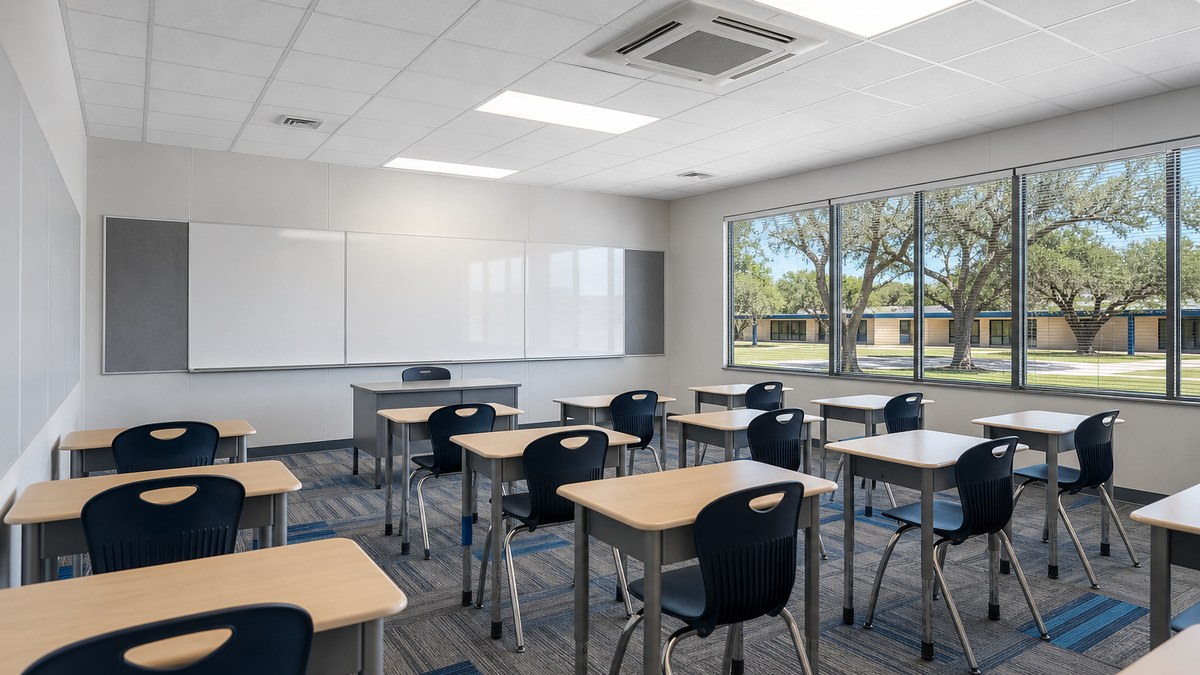
When you size a building, think about students per room (your class-size policy and grade level), storage, teacher work space, restrooms (especially for younger grades) and technology (displays, Wi-Fi access points, data drops). Special programs such as science, music, art and life-skills rooms may need sinks, casework, acoustic treatment or extra power.
What drives the cost of a portable classroom
We don't publish price lists, because two classrooms that look identical on paper can price very differently once they land on a real campus. These are the factors that actually move the number:
- New vs. used. Used and refurbished fleet units usually cost less and can be available sooner. New buildings let you choose the layout and finishes.
- Size and number of rooms. More floor area costs more, but multi-classroom buildings can share ramps, restrooms and HVAC, which lowers the cost per room.
- Restrooms and plumbing. Adding restrooms means water and sewer connections, which often costs more on site than in the factory.
- Site work. Pad preparation, drainage, utility runs from the main building, sidewalks and covered walkways are frequently the largest variable.
- Foundation or blocking for clay soils. North Texas clay shrinks and swells with moisture. Proper blocking, piers or foundations, and a plan for re-leveling, protect doors, windows and ramps from shifting.
- Ramps, steps and landings. Accessible routes and ramps are required and can be a meaningful line item.
- Fire alarm and life safety. Tying into the campus fire alarm system, emergency lighting and extinguishers.
- Delivery distance and access. Distance from the fleet yard or factory and how easily trucks and a crane or set crew can reach the pad.
- Term length (if leasing). Longer leases usually lower the monthly rate.
- Season. Summer demand in Texas is intense. Units and crews book up, which affects availability more than anything else.
The best way to get a reliable number is a quote based on your campus, your timeline and your room count. Send us those three things and we'll return lease and purchase options to compare.
Texas codes, permits and accessibility
Portable classrooms are real buildings, and Texas treats them that way. Here is how the pieces fit together (requirements vary by jurisdiction and project, so confirm with your architect, building official and fire marshal):
Built to code under the state industrialized building program
Commercial modular buildings in Texas, including classrooms, are regulated as industrialized buildings through the Texas Department of Licensing and Regulation (TDLR). Buildings are designed to the applicable codes, plan-reviewed and inspected during manufacture by approved third parties, and carry state documentation. That's why a modular classroom is built to the same code standards as a site-built one.
Local site permits
The building may be state-approved, but the site is local. The city building department, or the county for campuses outside city limits, typically reviews the foundation or blocking, utility connections, setbacks, fire access and placement. Many districts have a standing process with their city for portable placements; charter and private schools should confirm requirements early.
Accessibility (ADA and TAS)
Classrooms must be accessible. In Texas, accessibility is governed by the ADA and the Texas Accessibility Standards (TAS), which TDLR administers. Many publicly funded projects, and projects above TDLR's construction-cost threshold, must be registered with TDLR and reviewed and inspected by a Registered Accessibility Specialist (RAS). Plan the accessible route from the main building to the portable, including ramps, landings, handrails and door hardware, as part of the project, not an afterthought.
Fire and life safety
Expect the fire marshal to look at separation distances between portables and other buildings, fire lane access, fire alarm notification, exits and emergency lighting. Coordinate with your fire alarm vendor early if portables will tie into the campus system.
Tip: Ask your supplier for the building's state documentation and drawings at the quote stage. Your architect and city reviewer will want them, and having them early prevents summer delays.
Built for North Texas weather and soil
Classrooms in DFW face three local challenges, and good projects plan for each one:
- Heat. A full classroom on a 100°F afternoon produces a lot of heat. HVAC should be sized for full occupancy, and insulation, reflective roofing and shaded entries help. Ask about the HVAC unit's capacity and maintenance access.
- Spring storms, wind and hail. Buildings must be anchored for the local design wind speed. Impact-resistant roofing and siding options reduce hail damage.
- Expansive clay soils. Much of North Texas sits on clay that swells when wet and shrinks during drought. Movement shows up as sticking doors, cracked finishes and ramp gaps. Good drainage around the pad, the right blocking or pier system, and periodic re-leveling keep buildings square.
Winter matters too. After the hard freezes of recent years, it's worth asking about freeze protection for any plumbing and insulated skirting.
A realistic timeline for an August opening
Timing is where most portable projects succeed or fail. Here is a planning timeline many DFW schools follow. Your schedule depends on availability, permits and site work, and your quote should include a project-specific schedule.
| When | What happens |
|---|---|
| Fall–winter | Enrollment projections; decide how many rooms and where; lease vs. buy decision; budget approval. |
| Winter–early spring | Request quotes; select units; site survey; architect/engineer engaged if required; procurement or board approval. |
| Spring | Permit submittals (city/county, TDLR registration and RAS review where required); fire alarm coordination; order new buildings or reserve fleet units. |
| Late spring–early summer | Site work: pads, drainage, utilities, sidewalks. |
| Summer | Delivery, set, leveling, ramps, electrical and data, fire alarm tie-in; inspections. |
| Before first day | Final inspections, furniture, technology, cleaning; certificate of occupancy where required. |
New custom buildings need more lead time than fleet or used units because they are designed, approved and produced in a factory. If you're late in the season, ask what is available now, not just what is ideal.
Site planning checklist
Use this checklist before you request quotes. The more of it you can answer, the more accurate your pricing and schedule will be.
- Number of classrooms, grade levels and any special uses (science, music, pre-K, SPED).
- Restrooms in the building or use of existing campus restrooms.
- Proposed location on campus, with photos and a site plan if available.
- Distance to power, water, sewer and data.
- Truck and crane access: gates, overhead lines, trees, sports fields, slopes.
- Drainage: where water goes in a heavy rain.
- Accessible route to the main building and parking.
- Fire lane access and separation from other buildings.
- Covered walkways (often wanted for Texas sun and storms).
- Start date, end date (if leasing) and any blackout dates such as testing windows.
- Procurement method: direct purchase, competitive bid, or a cooperative purchasing contract.
Buying through bids and cooperative contracts
Public school districts follow state purchasing rules, which often means competitive bids, requests for proposals or purchasing through a cooperative contract. Charter schools have their own rules depending on their charter and funding. Private schools usually buy directly. Whatever the method, make sure every quote you compare includes the same scope: building, delivery, set, blocking or foundation, ramps and steps, skirting, electrical connection, fire alarm, and removal at the end of a lease.
New vs. used portable classrooms
Used classrooms can be a smart choice when the floor plan fits and the condition is good. Before you commit to a used unit, ask:
- Year built and the state documentation on the building.
- Condition of the roof, floor, HVAC, windows and doors.
- What refurbishment is included: paint, flooring, ceiling tiles, HVAC service.
- Whether the building meets current accessibility requirements for your project.
- Photos of the actual unit, not a catalog picture.
New buildings make sense for long-term use, custom layouts, or when you want specific finishes, energy performance or exterior colors that match the campus.
Three common DFW scenarios
1. Fast-growing suburban district
A district in Collin County projects two more elementary classrooms of growth at three campuses before a new school opens in two years. Leasing six classrooms in three duplex buildings, with removal at the end of the term, keeps the cost in the operating budget and avoids owning buildings it won't need later.
2. Renovation swing space in Dallas
An urban campus is being renovated in phases over 18 months. A multi-classroom building with an interior corridor and restrooms keeps students together and reduces trips between buildings. A lease with relocation to the next campus in the bond program can be priced up front.
3. New charter campus in Tarrant County
A charter school wants to open grades K–2 next August while it finances a permanent building. A leased classroom building with restrooms and an office module gets the campus open. Lease-to-own, where available, gives the school the option to keep the buildings later.
Frequently asked questions
How much does a portable classroom cost in Dallas?
It depends on new vs. used, size, restrooms, site work, foundation or blocking, ramps, delivery distance and whether you lease or buy. Because site work varies so much between campuses, the most accurate answer is a quote based on your room count, location and timeline.
How big is a standard portable classroom?
A common single classroom is about 24×32 to 24×40 feet. Double classrooms are often 24×64 or 48×40 feet. Sizes vary by manufacturer.
Can we lease portable classrooms for one school year?
Yes. One-year and multi-year leases are available, typically with delivery, setup and end-of-term removal included in the agreement. Confirm what is included in writing.
How long does it take to get a portable classroom?
Fleet and used units can move faster than new custom builds. Permits, site work and summer demand affect timing. Start planning in winter or early spring for an August opening.
Do portable classrooms in Texas need permits?
Usually, yes. The building itself is regulated through the state industrialized building program, while the city or county reviews the site, foundation, utilities and placement. Accessibility review may also apply.
Do portable classrooms need to be ADA accessible?
Yes. Classrooms and the route to them must meet the ADA and the Texas Accessibility Standards, including ramps, landings, handrails and door hardware.
Can portable classrooms have restrooms?
Yes. Restrooms can be built into the classroom or provided in a separate restroom building, depending on water and sewer access and the needs of younger students.
Can portables connect to our campus fire alarm?
Often, yes. This is coordinated with your fire alarm vendor and the fire marshal during planning.
How do Texas clay soils affect portable classrooms?
Expansive clay can move buildings as it swells and shrinks. Good drainage, the right blocking or foundation system and periodic re-leveling prevent sticking doors and ramp gaps.
Do you serve schools outside Dallas?
Yes. We serve districts and schools across Dallas-Fort Worth and Texas, including Frisco, McKinney, Denton, Arlington and many more locations.
Related
Sources
- Texas Department of Licensing and Regulation, Industrialized Housing and Buildings program.
- Texas Department of Licensing and Regulation, Architectural Barriers / Texas Accessibility Standards.
- McKinsey & Company, Modular construction: From projects to products (2019).
- Modular Building Institute, industry resources.
This guide is general information, not legal, code or procurement advice. Requirements vary by district, city, county and project; confirm with your architect, building official, fire marshal and purchasing department.