Home › Guides › Guard shacks & security booths for DFW logistics yards
Logistics & industrial security guide
Guard shacks & security booths for DFW logistics yards: sizes, options, codes and site planning
A practical guide for distribution center managers, 3PLs, developers, security directors and facility teams in North Texas: how to size a guard shack for a truck gate, which features matter in Texas heat, how bullet-resistant ratings work, how state and local rules treat small modular buildings, and what to settle before you request quotes.
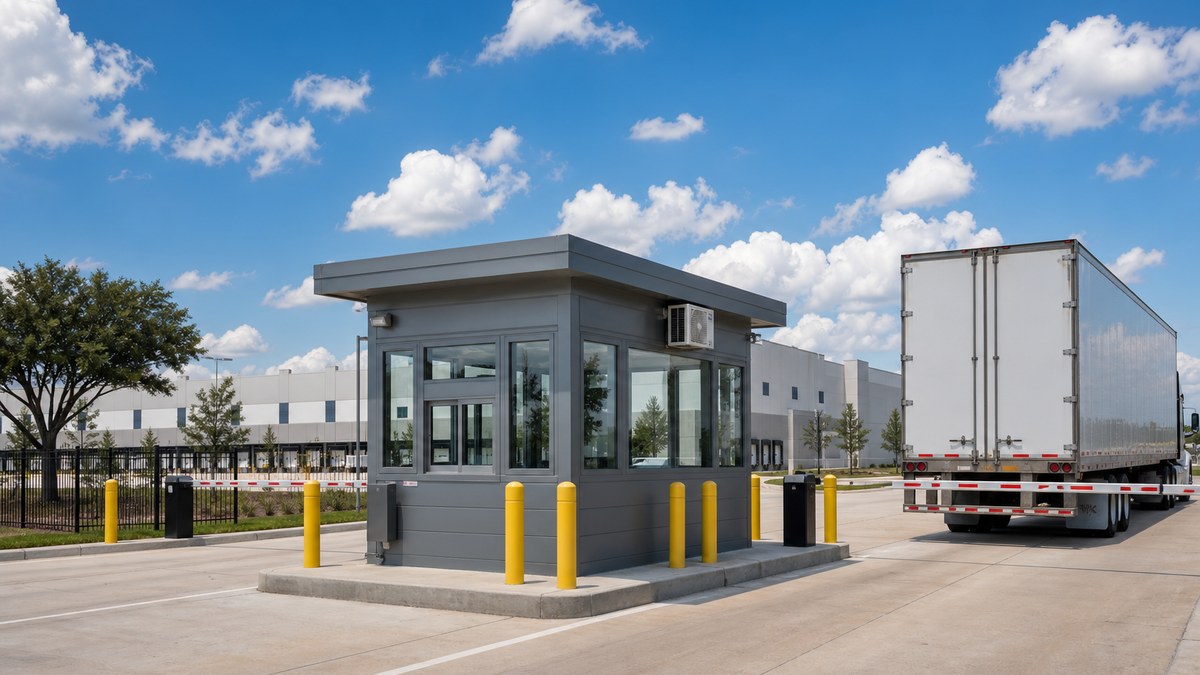
Guard shacks and security booths for DFW logistics yards are small prefabricated buildings placed at truck gates, employee entrances, trailer yards and parking lots so security officers and gate clerks can check in drivers, verify loads, log visitors and watch the property from a climate-controlled post. Most are built off site as finished modular units with windows on several sides, a service or transaction window, HVAC sized for Texas summers and wiring for cameras, access control and gate operators, then delivered on a truck and set on a pad or foundation. Through our network of manufacturers, dealers and installers, we help warehouses, cross-docks, manufacturers, developers and property managers across Dallas-Fort Worth and Texas compare sizes, options, lease and purchase for each gate; our specialty modular buildings and guard booths page shows the building family.
Quick answer: A guard shack for a DFW truck gate is usually a one- or two-person booth with glass on three or four sides, a sliding transaction window at truck-cab height, a compact HVAC unit, and pre-wiring for cameras, intercom, access control and gate arms. Larger gatehouses add a restroom, a break area or an office for the yard supervisor. Choose the size by how many people staff the post, how many lanes they serve and whether the post runs 24/7. Bullet-resistant walls and glass are rated to UL 752 levels when a threat assessment calls for them. Texas regulates many commercial modular buildings through TDLR's Industrialized Housing and Buildings program, but some small, non-public buildings that are not on a permanent foundation fall outside that program, so confirm the path with the supplier and your city. Costs depend on size, glazing, ballistic rating, HVAC, restroom, foundation, electrical and delivery, so get quotes for your actual gate.
This guide is general information, not engineering, code or security advice. Your building official, a licensed engineer and your security consultant have the final word. If you already know the site and the number of posts, request a free quote and we'll send back options that fit your gate.
Why guard shacks matter so much in North Texas
Dallas-Fort Worth is one of the largest industrial and distribution markets in the United States. Lee & Associates' third-quarter 2026 report puts the DFW industrial inventory at roughly 1.26 billion square feet, with about 50.1 million square feet still under construction at the end of the quarter. Those buildings are clustered in corridors many readers will know: the AllianceTexas area in north Fort Worth, Haslet and Roanoke; the southern Dallas County inland port around Lancaster, Wilmer and Hutchins; the Great Southwest area of Grand Prairie and Arlington; the DFW Airport north area around Coppell; and the I-20, I-35E, I-35W, I-30 and I-45 corridors.
Every one of those cross-docks, distribution centers and trailer yards has gates, and a busy gate is a control point for safety, security and throughput at the same time. A well-placed, well-equipped guard shack helps in several ways:
- Throughput. A clerk who can see the lanes, reach the driver window and scan paperwork without stepping into traffic keeps trucks moving and reduces queues backing onto public roads.
- Security. A staffed post with cameras, lighting and access control deters cargo theft and trespassing and creates a record of who came and went.
- Safety. Officers stay out of truck lanes, out of the summer sun and out of spring storms, with clear sightlines to pedestrians and yard trucks.
- Image. For tenants and visitors, the gatehouse is the first building they see. A clean, finished booth signals a well-run site.
Types of guard shacks and security booths
"Guard shack" covers a wide range of buildings. These are the types requested most often for DFW logistics and industrial sites, and what each usually involves.
| Type | Typical use | What to plan for |
|---|---|---|
| Single-officer booth | Employee parking gate, visitor entrance, secondary truck gate | Glass on three or four sides, compact HVAC, one work counter, power and data |
| Two-person gatehouse | Main truck gate with check-in and check-out lanes | Transaction windows on both sides, room for two workstations, printer and scanner space |
| Gatehouse with restroom | 24/7 posts far from the main building | Water and sewer or holding tank, accessible restroom where required, larger footprint |
| Gatehouse with office or break area | Yard supervisor, dispatch or shift change at the gate | Separate room, more glazing control, data and phone, often a small kitchenette |
| Bullet-resistant booth | High-value cargo, sites with prior incidents, critical infrastructure | UL 752 rated walls, doors and glass, rated transaction drawers, heavier base and anchoring |
| Parking and toll booth | Paid parking, event lots, visitor parking at corporate campuses | Cash or payment equipment, sliding windows on both sides, curb and island protection |
| Elevated or tower post | Large trailer yards and laydown areas where officers need to see over trailers | Stairs, guardrails, structural design, wind load, lightning protection |
For crew space beyond the gate, see our mobile offices, industrial modular buildings and storage and office containers pages.
How to size a guard shack for a truck gate
The most common mistake is buying a booth by the photo instead of by the job. Before you choose a size, answer five questions.
- How many people are in the booth at the busiest hour? One officer on nights and two clerks during the morning wave means you size for two.
- How many lanes does the post serve? A booth on a center island between an inbound and an outbound lane needs transaction windows on both sides.
- What equipment lives inside? Computers, monitors for the camera system, a printer, a radio charger, a key cabinet, a small refrigerator and a heater or fan all take counter and wall space.
- Is the post staffed 24/7? Around-the-clock posts usually justify a restroom or a short walk to one, a break area and more storage.
- Will paperwork go back and forth? Drivers hand over bills of lading and seal numbers. A window at truck-cab height, with a sill or drawer, matters more than floor space.
The size ranges below are typical for prefabricated guard buildings. The exact dimensions vary by manufacturer, and a supplier will recommend a size for your use.
| Booth | Typical footprint range | Good for |
|---|---|---|
| Compact booth | About 4×6 to 6×8 ft | One officer, one counter, parking or pedestrian gate |
| Standard gatehouse | About 6×10 to 8×12 ft | One or two people, truck check-in, camera monitors |
| Gatehouse with restroom | About 8×16 to 10×20 ft | 24/7 posts, remote gates |
| Gate building with office | About 12×20 ft and up, or a mobile office | Yard supervisor, dispatch, shift briefings |
Tip: Stand where the booth will go, at the height of a seated clerk, and look at every lane, the gate arms, the pedestrian walkway and the trailer drop area. If you cannot see them, move the booth, raise it or add glass and cameras before you order. Sightlines are much cheaper to fix on paper than after set day.
Features that matter in Texas
Heat, sun and HVAC
A small glass booth in a North Texas summer can become uncomfortable quickly. Ask for an HVAC unit sized for the booth's glazing and sun exposure rather than its floor area alone, insulated walls and roof, low-e or tinted glass, and a roof overhang or canopy on the sunny side. Wall-mounted or through-wall units save floor space; mini-split systems are quieter. For 24/7 posts, ask how the unit is serviced without shutting the gate down.
Storms, hail and wind
Spring storms bring hail and high winds to DFW. Anchoring should be designed for the site's wind load, and the roof, gutters and any canopy should be specified with that in mind. Tempered, laminated or bullet-resistant glass behaves differently in hail; discuss the glazing with the supplier. Our guide to the types of modular buildings explains how temporary and permanent foundations differ.
Visibility and glazing
- Glass on three or four sides, starting low enough to see a seated driver and a pedestrian.
- Sliding transaction windows at truck-cab height on the lane side, and at car height for visitor lanes.
- Glare control at night: interior lights that dim, exterior lights aimed away from the glass.
Power, data and security systems
Most of what makes a guard shack work is wiring. Plan conduit and boxes for:
- Camera system and monitors, including license-plate or trailer-number cameras if you use them.
- Access control readers, intercoms and call boxes at the gate.
- Gate operators and arms, loop detectors, and traffic lights for lane control.
- Data and phone, with a backup connection if the gate is critical.
- Emergency power or a generator connection if the post must stay open during outages.
Your security integrator and electrician should mark these up before the booth is built, so the factory can install the right boxes and the site contractor can bring conduit to the right side of the pad.
Protection from vehicles
A guard shack sits next to 80,000-pound trucks. Curbed islands, concrete-filled bollards and guardrail around the booth are part of the design, not an afterthought. Leave enough clear width for the widest load you accept, plus turning paths for trucks that stop at the window.
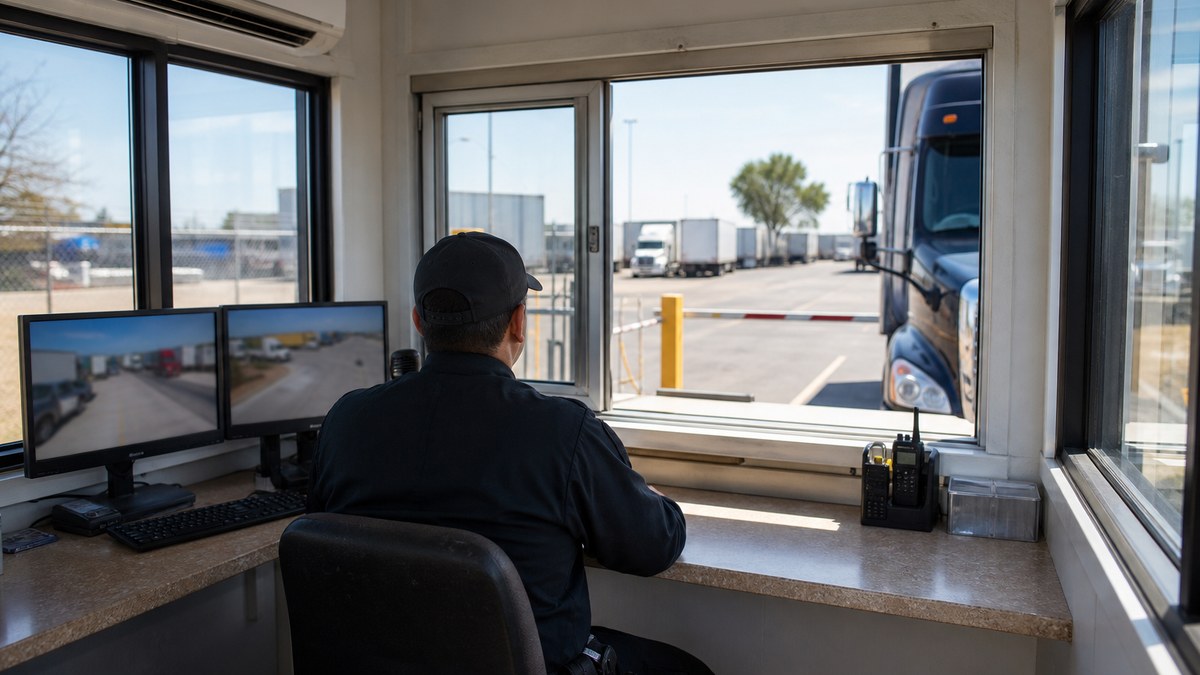
Bullet-resistant guard booths and UL 752
Not every gate needs a ballistic booth, but for high-value cargo, sites with a history of incidents, utilities and some government and data center sites, a bullet-resistant booth is part of the security plan. In the United States, bullet-resistant materials for buildings are commonly rated under UL 752, a standard that tests materials against defined firearm threats. Each level specifies the caliber, ammunition, number of shots and minimum velocity. Industry summaries describe the lower levels this way:
| UL 752 level | Test threat (summary) |
|---|---|
| Level 1 | Three shots of 9 mm |
| Level 2 | Three shots of .357 Magnum |
| Level 3 | Three shots of .44 Magnum |
| Level 4 | One shot of .30-06 rifle (soft point) |
| Level 8 | Five shots of 7.62 mm military ball rifle ammunition |
A few practical points:
- The whole envelope matters. Walls, doors, glass, transaction drawers, gaps at frames and penetrations for HVAC and wiring all need the same protection for the rating to mean anything.
- Higher levels are heavier. Rifle-rated glass and panels add weight, which affects the base, the anchoring, the delivery and the crane or forklift used to set the booth.
- Let a threat assessment pick the level. Your security consultant, insurer or corporate security standard should set the level; the supplier then builds to it and provides documentation.
Bullet-resistant options are also common on modular government buildings and security posts at public facilities.
Codes and permits: how Texas treats small modular buildings
This is the part most people skip, and it can stop a booth at the gate. Two layers apply: the state program for industrialized buildings and your city or county's local rules.
The state layer: TDLR's industrialized buildings program
Texas regulates commercial modular buildings through the Texas Department of Licensing and Regulation's Industrialized Housing and Buildings (IHB) program. Buildings in the program are built to TDLR-approved plans, inspected in the plant and labeled with a TDLR decal. TDLR guidance says cities may require local permits, inspect the foundation and on-site work and enforce zoning and setbacks, but may not require amendments to the mandatory building codes for these buildings.
TDLR's commercial building guide also lists structures that are outside the definition of an industrialized building. Among them are a construction site office that is not open to the public, and a structure that is not installed on a permanent foundation and either is not open to the public or is under 1,500 square feet and is not used as a school or place of religious worship. Many guard shacks are small, staff-only and set on a pad without a permanent foundation, so some will fall outside the IHB program, while a larger gatehouse on a permanent foundation, or one that serves the public, may be inside it. Ask the supplier how the booth is built and labeled, and confirm the path with TDLR and your city before you order.
The local layer: your city or county
Whatever the state path, the city or county still controls the site. Expect questions about:
- Zoning and setbacks. How far the booth sits from the right-of-way and property lines, and whether the gate layout works with the city's driveway rules.
- Driveway and queuing. Many cities want enough stacking distance inside the gate so trucks do not back up onto public streets. Your civil engineer usually handles this in the site plan.
- Electrical permit. Almost every booth needs one for the power connection, lighting and gate equipment.
- Plumbing permit. If the booth has a restroom or sink.
- Fire marshal. Gates on fire lanes must allow emergency access; many cities require a key box or an emergency override on gate operators.
- Temporary vs. permanent. A leased booth for a construction phase is usually reviewed differently from a permanent gatehouse on a finished site.
Requirements differ between Dallas, Fort Worth and each suburb, and unincorporated county land has its own path. Ask early; a pre-application meeting is the fastest way to find out.
Accessibility
Accessibility rules depend on the use. Under the 2010 ADA Standards, spaces used only by employees as work areas generally need to be designed so people with disabilities can approach, enter and exit them, and areas raised primarily for security purposes have specific exceptions. A booth that serves the public, such as a parking pay booth or a visitor check-in window, raises more questions. Texas applies the Texas Accessibility Standards through TDLR, and projects of $50,000 or more in estimated construction cost must be registered and reviewed by a Registered Accessibility Specialist. Your designer will confirm what applies to your booth and its restroom.
Restrooms for gate staff
Federal OSHA's sanitation standard for general industry (29 CFR 1910.141) requires employers to provide toilet facilities for employees. For a remote gate staffed around the clock, that is a practical reason to choose a gatehouse with a restroom, or to place a modular restroom building or a restroom trailer close to the post.
Foundations, pads and setting the booth
Much of North Texas sits on expansive clay that swells when wet and shrinks in drought. A guard shack is light compared with a warehouse, but it still needs a level, stable base and anchoring for wind.
- Concrete pad or island. Most booths sit on a concrete pad, often a raised curbed island between lanes, with anchor points designed for the booth and the site's wind load.
- Permanent foundation. Larger gatehouses that will stay for many years are often set on a permanent foundation designed by a Texas-licensed engineer.
- Conduit stub-ups. Power, data and gate-equipment conduit should come up exactly where the booth's openings are. Get the booth's floor plan before the pad is poured.
- Drainage. Slope the pad and the lane away from the booth door; standing water at a gate is a slip and freeze hazard.
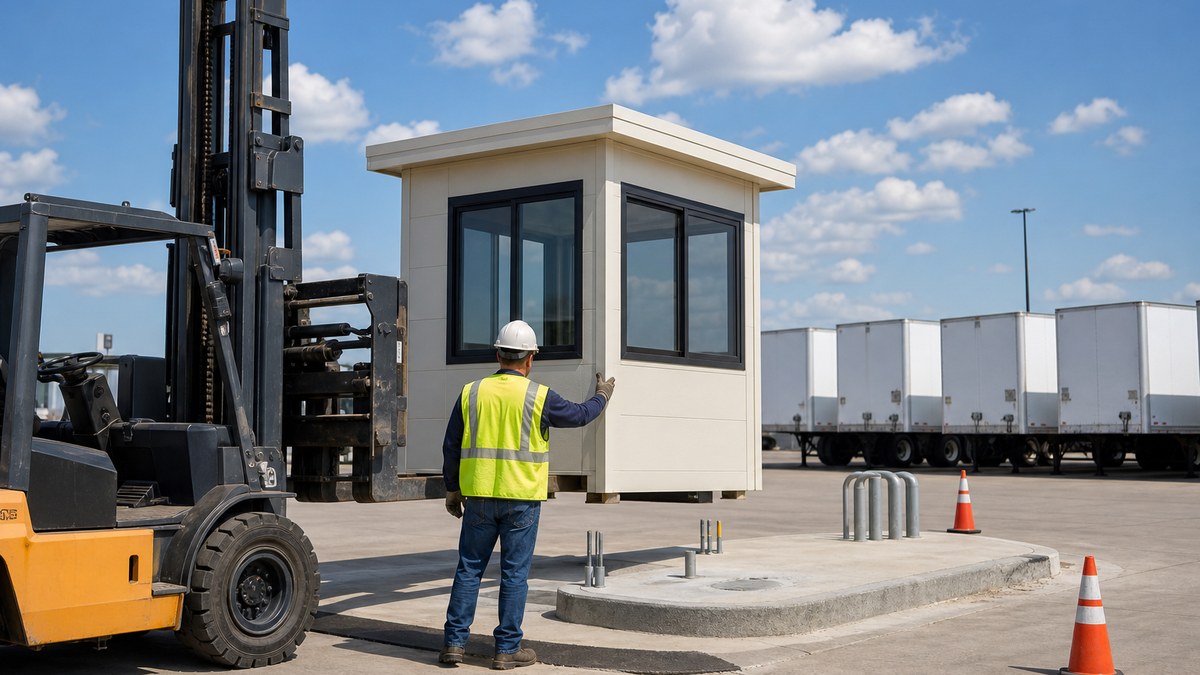
- Setting. Small booths are often set with a forklift or a truck-mounted crane; larger ones may need a crane. Plan the set when the gate can be closed or rerouted.
Our sales, leasing, delivery and relocation services page explains how delivery and setup are coordinated through our network.
Lease, buy, new or used
| Path | Fits when | Trade-offs |
|---|---|---|
| Lease or rent | Construction phases, seasonal peaks, a temporary second gate, a site you will vacate | Standard layouts and finishes; ballistic options may be limited |
| Buy, standard model | A permanent gate on a site you own or have a long lease on | Ownership and maintenance; choose options carefully up front |
| Buy, custom | Branded gatehouses, multi-lane plazas, ballistic or elevated posts | Longer design and approval phase; see our custom modular buildings |
| Used or relocated | Tight budget, standard needs | Check condition, glazing, HVAC, wiring and any labels; ballistic ratings must be documented |
Booths are designed to be moved by forklift or crane, so a booth bought for one site can often be relocated when a lease ends or a gate is rebuilt. Plan the relocation cost into the decision.
Cost factors (no guesswork prices)
We don't publish prices because guard shacks range from compact booths to custom ballistic gatehouses, and quotes change with the market. These factors move the number most:
- Size and layout. Footprint, number of workstations, a restroom or a second room.
- Glazing. How much glass, the type of glass and the number of sliding or transaction windows.
- Ballistic rating. UL 752 level for walls, doors, glass and transaction drawers.
- HVAC and insulation. Unit type and capacity for a glass booth in Texas sun.
- Electrical and low-voltage prep. Panel size, lighting, conduit and boxes for cameras, access control and gate equipment.
- Restroom and plumbing. Fixtures, water heater, and the site connection or holding tank.
- Exterior finish. Painted steel, metal panel, stucco-look or masonry-look finishes, canopies and roof style.
- Base and site work. Pad or island, bollards, anchoring, conduit, drainage and paving.
- Delivery and setting. Distance, route, forklift or crane, and working around an active gate.
- Lease or purchase. Term, new or used, and removal at the end.
Compare quotes on the same scope: booth, options, delivery, setting, anchoring, electrical connection, and what your site contractor or integrator is expected to provide.
Speed: what modular does and does not change
Because the booth is built in a plant while the pad, conduit and gate equipment are prepared on site, the overall schedule can be shorter than building a gatehouse in place. McKinsey & Company's 2019 report on modular construction found that modular approaches can accelerate project timelines by 20 to 50 percent, depending on the project. For a guard shack, the long poles are usually permits, the site plan, electrical work and gate equipment, not the booth itself, and availability of lease units changes week to week. We confirm a realistic schedule with each quote rather than promising a date.
Six DFW gate scenarios
1. New cross-dock in Lancaster
A developer finishing a speculative cross-dock near Lancaster in the southern Dallas County inland port needs a two-lane truck gate before the first tenant moves in. A standard gatehouse with transaction windows on both sides, set on a curbed island with bollards and conduit for cameras and gate arms, gives the tenant a working gate on day one.
2. Trailer yard in north Fort Worth
A carrier with a large drop-trailer yard near AllianceTexas in Fort Worth needs to see over rows of trailers at night. An elevated post with stairs, guardrails and cameras, plus a ground-level booth at the gate, covers both jobs.
3. 24/7 gate in Grand Prairie
A distribution center in Grand Prairie runs three shifts and the truck gate is a long walk from the main building. A gatehouse with an accessible restroom and a small break area keeps the post staffed without officers leaving the gate.
4. Plant expansion in Midlothian
A manufacturer in Midlothian builds a new production line and needs a temporary contractor gate for two years. A leased booth on a pad, plus a construction trailer for badging, keeps contractor traffic separate from the main entrance, then goes back when the project is done.
5. High-value cargo in Coppell
A 3PL near DFW Airport in Coppell handles electronics and pharmaceuticals, and its insurer asks for a hardened gate. A bullet-resistant booth at the level set by the threat assessment, with rated glass and a transaction drawer, replaces an older unrated shack.
6. Employee parking at a campus in Irving
A corporate campus in Irving wants a visitor check-in booth at the parking entrance that matches its buildings. A compact booth with a stucco-look finish and a canopy, wired for an intercom and access control, gives visitors a finished welcome.
We help with the same kinds of gates in Dallas, Arlington, Haltom City, Saginaw, Roanoke, Denton, Lewisville, Carrollton, Garland, Mesquite, Forney, Wylie, Houston and Laredo, and across our Texas service area.
Common mistakes with guard shacks
- Choosing the booth before the gate layout. Lane widths, turning paths, queuing distance and the island come first; the booth fits the layout, not the other way around.
- Putting the window at car height on a truck gate. Drivers in a cab sit well above a sedan; the transaction window has to meet them.
- Undersizing the HVAC. A glass booth facing west in July needs more cooling than its floor area suggests.
- Forgetting conduit. Pouring the pad before the integrator marks up cameras, readers, loops and gate arms means saw-cutting later.
- Skipping vehicle protection. Bollards and curbs are cheap compared with a booth hit by a trailer.
- Buying "bullet-resistant" without documentation. Ask for the rating and test documentation for walls, glass and drawers, not just the glass.
- No plan for restrooms. A 24/7 post needs a restroom within reasonable reach.
- Not checking the permit path. Even a small booth usually needs an electrical permit, and the gate layout often needs city review.
Checklist before you request quotes
- Site address, and whether it is inside city limits or on county land.
- Gate type: truck, employee, visitor, parking, contractor or yard.
- Number of lanes and which sides need transaction windows.
- Staffing: how many people at the busiest hour, and whether the post runs 24/7.
- Equipment inside: computers, monitors, printer, radios, key cabinet.
- Restroom, break area or office needed.
- Ballistic level, if your security standard or insurer requires one.
- Exterior finish expectations and any landlord or campus design standards.
- Utilities near the gate: power, data, water and sewer.
- Lease or buy, how long you need it, and whether it may move later.
- Target date and any tenant move-in or project milestones.
Send that through our quote form or call (702) 738-2218, and we'll return options through our network of manufacturers, dealers and installers, matched to your gate.
Frequently asked questions
What is a guard shack?
A guard shack is a small building at a gate, entrance or parking lot where a security officer or gate clerk works. Most are prefabricated booths or gatehouses with windows on several sides, a transaction window, HVAC and wiring for cameras, access control and gate equipment.
What size guard shack do I need for a truck gate?
Size it by the number of people at the busiest hour, the number of lanes, the equipment inside and whether the post runs 24/7. A one- or two-person gatehouse in the range of about 6x10 to 8x12 feet is common for a truck gate, and 24/7 posts often add a restroom.
Do guard shacks need a permit in Dallas-Fort Worth?
Usually some permit is needed. Almost every booth needs an electrical permit, a restroom adds plumbing, and the gate layout may need site plan, driveway and fire marshal review. Requirements differ between Dallas, Fort Worth, each suburb and county land, so check with the local building department early.
Is a guard shack regulated by TDLR?
It depends on the building. TDLR's Industrialized Housing and Buildings program covers many commercial modular buildings, but its guidance excludes some structures that are not on a permanent foundation and are either not open to the public or under 1,500 square feet and not a school or place of worship. Confirm the path for your booth with the supplier, TDLR and your city.
What does bullet-resistant mean for a guard booth?
Bullet-resistant booths use walls, doors, glass and transaction drawers tested to a standard such as UL 752, which rates materials against specific firearms and ammunition. Lower levels cover handguns and higher levels cover rifles. A threat assessment should set the level, and the supplier should document it.
Can a guard shack have a restroom?
Yes. Many gatehouses in the 8x16 to 10x20 foot range include a restroom. It needs a water supply and a sewer connection or holding tank, and accessibility requirements may apply. Federal OSHA rules require employers to provide toilet facilities for employees, so remote 24/7 posts often include one.
How is a guard shack installed?
The site contractor prepares a level concrete pad or island with conduit stub-ups and anchor points. The booth is delivered finished and set with a forklift or crane, anchored for wind, then connected to power, data and any plumbing. Bollards and curbs protect it from vehicles.
Can I rent a guard shack for a construction project?
Yes. Lease and rental booths are common for construction phases, temporary gates and seasonal peaks. Availability and options change, and ballistic options may be limited on rental units, so share your dates and requirements with the quote request.
How do I keep a guard booth cool in Texas summers?
Ask for HVAC sized for the booth's glass and sun exposure, insulated walls and roof, low-e or tinted glass, and an overhang or canopy on the sunny side. Orientation matters too: a booth with its largest windows facing west will need more cooling.
How much does a guard shack cost?
It depends on size, glazing, ballistic rating, HVAC, restroom, exterior finish, electrical and low-voltage prep, the pad and site work, delivery and setting, and lease or purchase. We don't publish prices; request a quote with your site and gate details and compare quotes that cover the same scope. Call (702) 738-2218.
Related
Also see our modular buildings for manufacturing, commercial businesses, EV charging and fleet depot buildings, portable classrooms guide, all building types and industries we serve.
Sources
- Lee & Associates, Q3 2026 Dallas-Fort Worth Industrial Market Report.
- Texas Department of Licensing and Regulation, Industrialized Buildings: Commercial Building Guide (definitions and exclusions).
- Texas Department of Licensing and Regulation, IHB building site inspections and local permits.
- Texas Department of Licensing and Regulation, Architectural Barriers FAQ (TAS registration threshold).
- U.S. Department of Justice, 2010 ADA Standards for Accessible Design (employee work areas, raised security areas).
- U.S. Occupational Safety and Health Administration, 29 CFR 1910.141, Sanitation.
- UL Standard 752, Bullet-Resisting Equipment (level summaries as published in industry guides).
- McKinsey & Company, Modular construction: From projects to products (2019).
This guide is general information, not engineering, security, legal or code advice. Permit, accessibility and building rules are set by each city, county and state agency and change over time; confirm with your building official, TDLR, your security consultant and licensed professionals before you buy, lease or install.