Home › Guides › Modular buildings for Texas weather
Texas weather & specification guide
Hail, wind & heat: how to specify modular buildings for Texas weather
A practical guide for facility managers, school districts, contractors, clinics and developers in Dallas-Fort Worth and across Texas: what North Texas hail, spring wind, summer heat and the occasional hard freeze do to mobile offices, portable classrooms and commercial modular buildings, and which options to put in the spec before you request quotes.
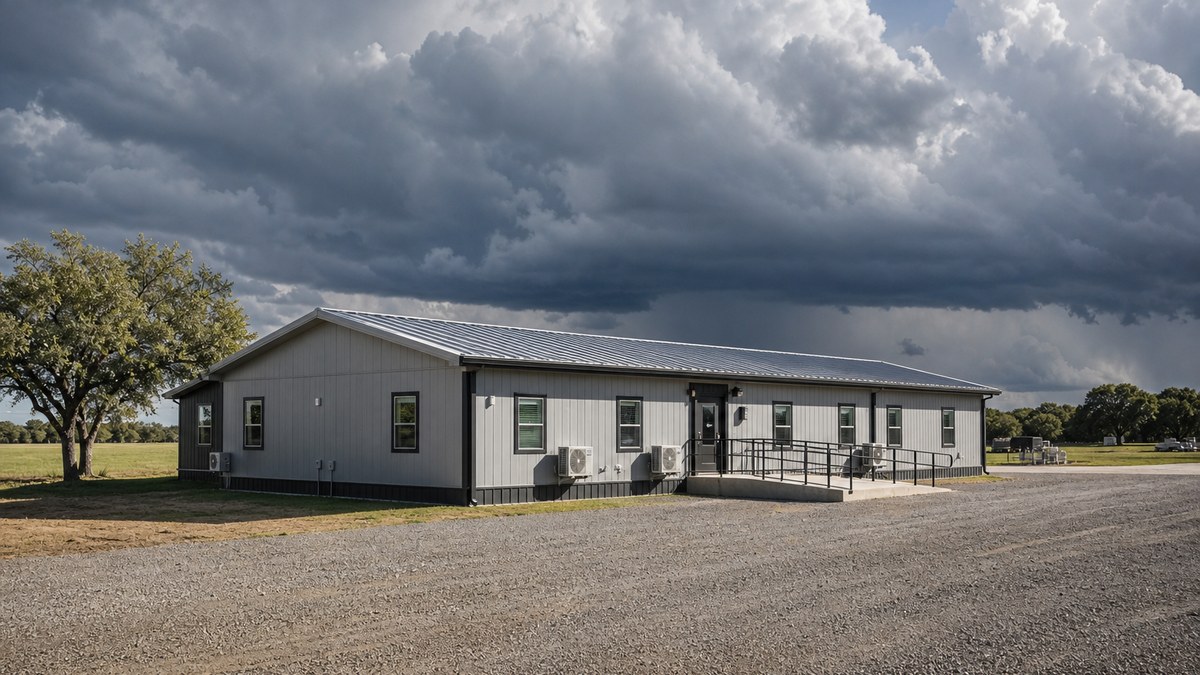
Specifying modular buildings for Texas weather means choosing the roof, walls, windows, HVAC, anchoring and foundation of a mobile office, portable classroom or commercial modular building so it holds up to hail, high wind, long stretches of 100-degree heat and the occasional hard freeze. Every commercial modular building is designed to code wind loads and energy rules, but the code is a minimum: hail resistance, cooling capacity for a sun-baked south wall, freeze protection for plumbing and tie-downs on expansive clay are choices you make in the spec. Through our network of manufacturers, dealers and installers, we help businesses, schools, contractors and public agencies across Dallas-Fort Worth and Texas compare buildings and options for the weather they will actually see. Our modular buildings overview explains the main building families.
Quick answer: For North Texas weather, ask for impact-rated roofing (UL 2218 Class 4 or an FM hail rating) or a metal roof with a heavier gauge, tie-downs and anchors designed for the site's wind speed and soil, HVAC sized for solar load rather than square footage alone, low-e glass and shading on south and west walls, insulated and heat-traced plumbing with a freeze plan, skirting with ventilation, and a foundation or blocking plan for expansive clay. Texas regulates commercial modular buildings through TDLR's Industrialized Housing and Buildings program, which since July 1, 2024 uses the 2021 International Building Code, so wind and structural minimums are set by code; hail upgrades and comfort options are yours to specify. Costs depend on the building, the options and the site, so compare quotes on the same spec.
This guide is general information, not engineering or code advice. A Texas-licensed engineer, your building official and the manufacturer have the final word on loads, anchoring and foundations. If you already know the building and the site, request a free quote and we'll send back options with the weather upgrades priced separately so you can compare.
Why Texas weather deserves its own line in the spec
Texas sees almost every kind of severe weather a building can face, often in the same year. A few numbers show why it matters:
- Hail. Texas has led the United States in major hail events for 11 years in a row. Insurance Information Institute figures reported in May 2026 counted 902 hail events with major damage in Texas in 2025, far ahead of second-place Illinois with 375. Cotality's 2026 severe convective storm report estimates that nearly 8 million Texas properties face moderate or greater hail risk, more than any other state, and names Dallas-Fort Worth among the most exposed metros in the country.
- Heat. The National Weather Service in Fort Worth records an average first 100-degree day at DFW around July 1 and an average last one around August 27. The record is 71 days of 100 degrees or more in 2011, and the longest streak is 42 days in a row in 1980.
- Wind and storms. Spring and early summer bring squall lines, downbursts and tornado watches to North Texas. Straight-line winds can damage a lightly anchored building as badly as a weak tornado.
- Freeze. Hard freezes are rare but real. The February 2021 winter storm pushed DFW below zero and left buildings across Texas without power for days, which is when exposed pipes in crawl spaces and skirted buildings burst.
- Soil. Much of North Texas sits on expansive clay that swells in wet springs and shrinks in drought, which moves blocking, piers and tie-down anchors over time.
A modular building is built in a plant to a set of approved plans, then trucked to the site and set. That makes it easy to add weather options at the factory, where they are cheaper and better controlled, and expensive to add them after a storm. The spec is where you decide.
The code baseline: what is already covered
Before you add upgrades, it helps to know what every commercial modular building in Texas already has to meet.
TDLR and the 2021 codes
Texas regulates commercial modular buildings through the Texas Department of Licensing and Regulation's Industrialized Housing and Buildings (IHB) program. Buildings in the program are built to TDLR-approved plans, inspected in the plant and labeled with a TDLR decal. TDLR adopted new code editions for the program effective July 1, 2024, including the 2021 International Building Code, the 2021 International Mechanical and Plumbing Codes, the 2020 National Electrical Code and the 2015 International Energy Conservation Code, with the 2021 International Existing Building Code for alterations to portable buildings.
Wind loads are set by code, and by your site
The building code requires the structure and its connections to resist the design wind speed for the location, taken from the national wind maps the code references. TDLR guidance notes that a city does not have to accept a building designed for a lower wind speed than the code map shows for that location. In practice, that means your supplier should confirm the building is designed for your site's wind speed and exposure, and the anchoring and foundation should be designed to match. Open sites, such as a school field, a plant expansion pad or a rural crew camp, see more wind than a lot surrounded by buildings and trees.
What the code does not cover
- Hail. The International Building Code has no explicit hail-resistance requirement for roofing or walls. Impact-rated roofing is an owner's choice, though some insurers ask for it.
- Comfort cooling. The code sets equipment and envelope minimums; it does not guarantee that a classroom full of students stays comfortable on a west-facing wall in August.
- Freeze protection beyond the minimum. Heat tape, insulated skirting and a shutdown plan for long outages are practical choices, not code mandates for every building.
- Soil movement over time. Foundations must be designed by a Texas-licensed engineer or architect, but the level of re-leveling and monitoring you plan for is a maintenance decision.
Cities may require local permits, inspect the foundation and on-site work, and enforce zoning and setbacks for IHB buildings, but they may not require amendments to the mandatory codes. See our sales, leasing, delivery and relocation services page for how setup and inspections are coordinated.
Hail: roofs, siding, windows and HVAC
Hail is the weather risk DFW owners ask about most. A single spring storm can dent metal roofs, crack skylights, shred HVAC coil fins and break windows across a whole campus of portable classrooms or a row of construction trailers.
Roofing
Two test standards are used to compare roofing for hail:
| Standard | How it tests | What the rating means |
|---|---|---|
| UL 2218 | Steel balls dropped from set heights onto the roof covering | Class 1 to Class 4; Class 4 is the most resistant and corresponds to the impact energy of a 2-inch hailstone |
| FM 4473 | Ice balls fired at the roof covering | Rated for moderate hail (under 1.75 in.), severe hail (1.75 to 2 in.) or very severe hail (over 2 in.) |
For mobile offices and many smaller modular buildings, the roof is often a membrane, a coated deck or a metal roof. Questions to ask:
- What is the roof covering, and does it carry a UL 2218 or FM hail rating?
- For a metal roof, what gauge and profile? Heavier gauges and stiffer profiles resist cosmetic denting better; dents are not always leaks, but they matter for appearance and insurance.
- For a membrane roof, is there a cover board or thicker membrane option that improves hail resistance?
- Are skylights avoided or protected? Plastic skylight domes are a common weak point.
- Does the roof warranty exclude hail damage, and what does your insurer require?
Siding and walls
Vinyl and thin painted metal siding can crack or dent in large hail. On buildings that will stay for years, ask about heavier metal panels, fiber-cement, stucco-look or masonry-look finishes, especially on the side that faces the prevailing storm direction (in North Texas, storms often arrive from the west and northwest).
Windows and doors
Ask for tempered or laminated glass where breakage would be dangerous or costly, such as classrooms, clinics and public counters. Exterior shutters or screens are an option for buildings left empty for long stretches.
HVAC units
Most modular buildings use wall-mounted or packaged units on the outside wall or roof. Hail flattens condenser coil fins, which cuts cooling capacity just before summer. Hail guards over the coil are an inexpensive upgrade, and placing units on the sheltered side of the building helps.
Tip: After any hail event, photograph the roof, siding, windows and HVAC coils before anything is repaired, and notify your lessor or insurer. On leased buildings, the lease usually says who carries the risk and who repairs what. Read that clause before storm season, not after.
Wind: anchoring, tie-downs and set-up
Most wind damage to modular buildings comes from how the building is held down, not from the walls themselves. A building that is designed for the right wind speed but poorly anchored can still shift, rack or roll.
Temporary vs. permanent foundations
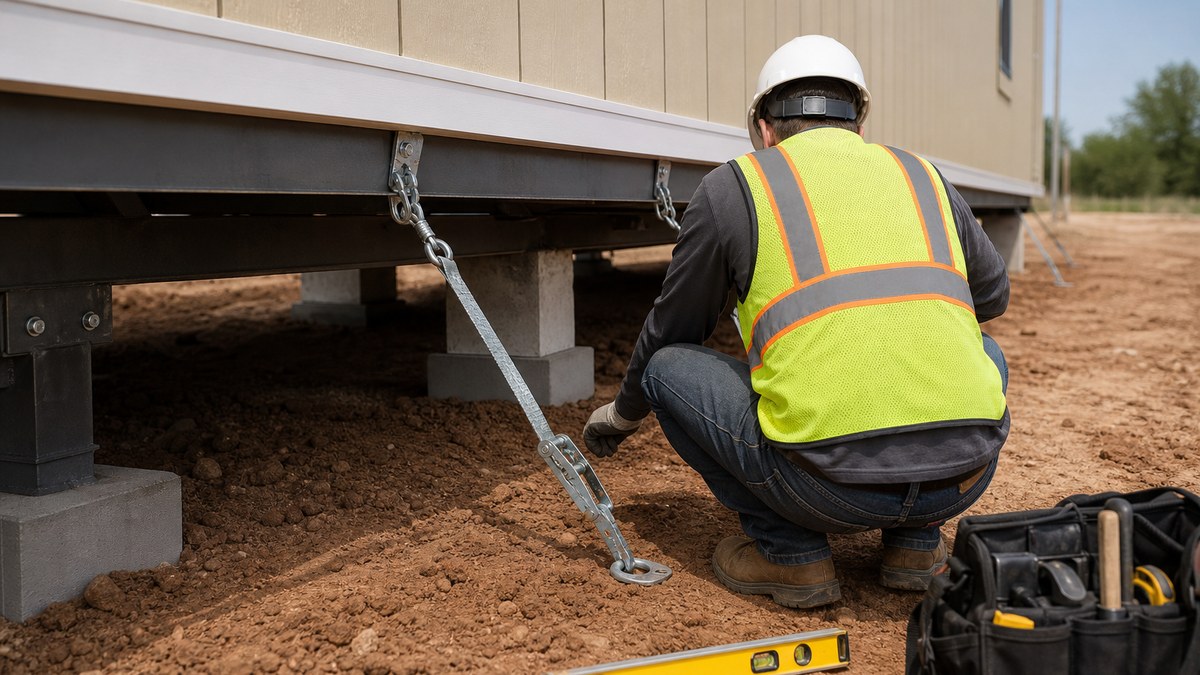
TDLR allows commercial industrialized buildings to be placed on a temporary foundation, typically blocking with tie-downs and ground anchors, where the city authorizes it; the chassis may stay on. Ground anchors are not approved for permanent foundations, which use engineered piers, slabs or perimeter foundations instead. Industrialized housing (residential) always requires a permanent foundation. Whichever path you take, the foundation must be designed by a Texas-licensed engineer or architect for the site's wind load and soil.
What to check on set day
- Anchor type and spacing match the engineered plan for your soil and wind speed.
- Straps are tensioned and connected to the frame at the specified points.
- Blocking is level and sits on suitable pads, not loose fill.
- Steps, ramps, canopies and decks are anchored too. Loose ramps and awnings are frequent wind casualties.
- Multi-section buildings are fastened across the marriage lines as specified.
Open sites and exposed locations
School fields, plant pads, rural crew camps and laydown yards are open and windy. Ask the engineer whether the site's exposure category raises the anchoring design, and keep loose materials, dumpsters and stacked storage away from the building.
For crew sites, see our construction site trailers, mobile offices and workforce housing pages.
Heat: cooling, insulation and solar load
Heat is the risk Texas owners feel every day from June to September. A modular classroom, clinic or office that is comfortable in May can struggle in August if the HVAC and envelope were chosen by square footage alone.
Size HVAC for the load, not the floor area
Cooling load depends on glass area and orientation, roof color and insulation, occupancy (a classroom with 25 students produces much more heat than an office with two people), equipment such as computers and medical devices, and outside air requirements. Ask the supplier for the load basis behind the unit size. For classrooms, clinics and server or equipment rooms, consider:
- Larger or additional units, or a split system for quieter operation.
- A second unit or a redundant unit for rooms that cannot lose cooling.
- Programmable or connected thermostats so buildings can pre-cool before the school day or shift.
- Service access that does not require shutting the building down.
Envelope options that cut heat gain
| Option | What it does | Where it pays off most |
|---|---|---|
| Reflective (cool) roof surface | Reflects more sunlight, lowering roof temperature | Single-story buildings with large roofs |
| Added roof and wall insulation | Slows heat flow into the building | Buildings used all day in summer |
| Low-e or tinted glass | Cuts solar heat through windows | South and west walls, offices, clinics |
| Overhangs, canopies, awnings | Shade windows and doors | Entrances, transaction windows, west walls |
| Vestibules or air curtains | Reduce hot air at frequently used doors | Classrooms, clinics, sales offices |
| Orientation on site | Puts the long walls north and south | Any site with room to rotate the building |
Texas sits mostly in warm climate zones under the energy code, and Dallas and Tarrant counties are in the warm-humid zone, so humidity control matters as much as temperature in many buildings. Ask how the HVAC handles dehumidification, especially for buildings that sit closed over summer breaks.
Heat safety for people
For crews, students and patients, the building is often the cool-down space. For construction and industrial sites, a cooled mobile office or break room close to the work area supports a heat-illness prevention plan. For schools, see our portable classrooms guide and modular classrooms page for HVAC and layout questions districts ask.
Freeze: plumbing, skirting and outages
Hard freezes are rare in North Texas, which is exactly why buildings are often unprepared. Restroom buildings, kitchens, clinics and workforce housing with plumbing are the most exposed.
- Insulate and protect pipes. Keep supply and drain lines inside the insulated envelope where possible; where they run under the floor or to the meter, insulate them and add heat tape on a protected circuit.
- Skirting. Skirting keeps wind out of the crawl space and protects pipes, but it needs vents for summer moisture. Insulated skirting is worth considering for buildings with plumbing.
- Shutoff and drain-down plan. Label the main shutoff and drain points, and write down who shuts the building down if power is lost for a long period.
- Backup power. For critical buildings, a generator connection or transfer switch lets heat and heat tape run during outages.
- Water heaters and fixtures. Tankless and tank water heaters, eyewash stations and exterior hose bibbs all need freeze protection.
For buildings with plumbing, see our modular restroom buildings, restroom trailers, modular kitchens and modular medical buildings pages.
Rain, drainage and expansive clay
Heavy spring rain and North Texas clay soils cause slow, expensive problems: water ponding under the building, soil swelling under blocking, and doors that stop closing as the building goes out of level.
- Grade away from the building. The pad should shed water away from the perimeter and away from ramps and steps.
- Gutters and downspouts. Carry roof water away from the foundation, not onto it.
- Soil and foundation design. TDLR's technical bulletin on expansive soils and a site-specific geotechnical report guide the engineer's foundation design for longer-term buildings.
- Re-leveling. For buildings on blocking, plan a level check after the first wet season and after long droughts. Small adjustments are routine; large movements point to a drainage problem.
- Vapor and moisture. Ventilated skirting and a ground cover keep crawl spaces from turning into humidity sources in summer.
Weather checklist by building type
| Building | Top weather priorities |
|---|---|
| Mobile offices and construction trailers | Anchoring on open sites, hail guards on HVAC, secured steps and ramps, enough cooling for crews coming in from the heat |
| Portable classrooms | HVAC sized for full occupancy, tempered glass, hail-rated roofing on long-term buildings, covered walkways, freeze plan over winter break |
| Clinics and medical buildings | Redundant cooling, backup power, humidity control, freeze-protected plumbing |
| Restroom buildings | Freeze protection, insulated skirting, drainage, ventilation |
| Modular kitchens | Make-up air and cooling for kitchen heat, grease and roof penetrations sealed for hail, freeze-protected plumbing |
| Workforce housing | Wind anchoring on open sites, sleeping-room comfort, permanent foundations where required, freeze plan |
| Storage and office containers | Insulation and ventilation to control heat and condensation, roof drainage |
| Permanent commercial modular | Impact-rated roofing, durable siding, engineered permanent foundation, cool roof and low-e glass |
Lease vs. buy: who carries the weather risk?
On a purchased building, you own the weather risk and choose the upgrades. On a leased or rented building, the answer depends on the lease. Ask before you sign:
- Who insures the building, and is hail or wind damage excluded or subject to a deductible?
- Who arranges and pays for repairs after a storm, and how quickly?
- Can weather options, such as hail guards, heat tape or added HVAC, be added to a lease unit?
- Who re-levels the building and checks tie-downs after storms or soil movement?
- What happens to the lease if the building is unusable after a storm?
Our mobile office trailer rental guide covers more lease questions, and our custom modular buildings page explains how options are specified on new buildings.
Cost factors (no guesswork prices)
We don't publish prices because weather upgrades depend on the building, the site and the market. These factors move the number most:
- Roofing. Covering type, hail rating, metal gauge, cover boards and skylight protection.
- Exterior finish. Siding material and thickness, especially on storm-facing walls.
- Glazing. Tempered, laminated or low-e glass, and window count and size.
- HVAC. Unit size, number of units, redundancy, hail guards and controls.
- Insulation. Roof, wall and floor insulation levels and a reflective roof surface.
- Freeze protection. Heat tape, pipe insulation, insulated skirting and backup power.
- Foundation and anchoring. Temporary blocking and anchors vs. an engineered permanent foundation, geotechnical work and site drainage.
- Site work. Grading, gutters, downspouts, covered walkways and canopies.
- Lease or purchase. Which upgrades are available on lease units, term length and insurance terms.
Ask suppliers to list weather upgrades as separate line items. That makes it easier to compare quotes and decide which options are worth it for how long the building will stay.
Speed: building weather options in at the factory
Because modular buildings are built in a plant while the site is prepared, weather options are installed under controlled conditions instead of on a rainy jobsite. McKinsey & Company's 2019 report on modular construction found that modular approaches can accelerate project timelines by 20 to 50 percent, depending on the project. For weather upgrades, the bigger benefit is timing: specifying them up front avoids retrofits after the first storm. Upgrade availability and schedules change with each manufacturer, so we confirm them with each quote rather than promising a date.
Six DFW weather scenarios
1. Portable classrooms in Frisco
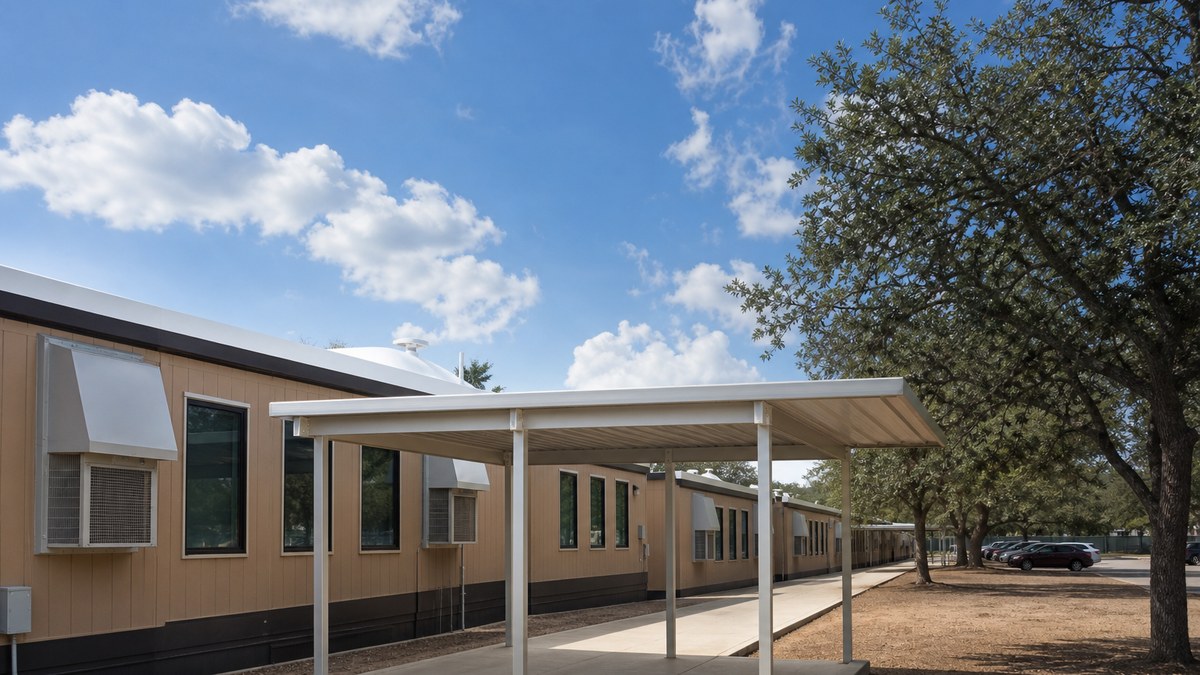
A district adding portables at a fast-growing campus in Frisco wants buildings that stay comfortable at the start of the school year in August. It specifies HVAC sized for full classrooms, low-e glass, a reflective roof and covered walkways between the portables and the main building.
2. Construction trailers on an open site in north Fort Worth
A general contractor setting a two-year field office complex on an open pad near AllianceTexas in Fort Worth asks the engineer to confirm the anchoring for the site's exposure, adds hail guards to the HVAC and anchors the ramps and canopies.
3. Clinic in McKinney
A healthcare provider placing a modular clinic in McKinney chooses impact-rated roofing, redundant cooling for exam rooms, a generator connection and freeze-protected plumbing so the clinic can stay open through a storm or outage.
4. Restroom building at a park in Mansfield
A city adding a restroom building at a sports complex in Mansfield plans insulated skirting, heat tape on a protected circuit, labeled shutoffs and a winter drain-down procedure for the off-season.
5. Workforce housing near a plant site in Ennis
A contractor housing crews for an industrial project near Ennis sets the buildings on an open site with engineered anchoring, sleeping rooms with their own HVAC, and a site drainage plan for heavy spring rain on clay.
6. Sales office in Celina
A homebuilder opening a model-home sales office in Celina wants it to look like a permanent building and survive hail. It chooses a metal roof with a heavier gauge, fiber-cement-look siding, a deep front canopy and low-e glass.
We help with weather-ready buildings in Dallas, Arlington, Plano, Denton, Garland, Irving, Grand Prairie, Weatherford, Waxahachie, Rockwall, Lubbock, Amarillo, Houston and Corpus Christi, and across our Texas service area.
Common mistakes
- Sizing HVAC by square footage. A full classroom or a west-facing office needs more cooling than the floor area suggests.
- Assuming code means hail-proof. The building code does not require hail-rated roofing; ask for it if you need it.
- Skipping the anchoring check. The building can be designed for the right wind speed and still be set with the wrong anchors for the soil.
- Forgetting the extras. Ramps, steps, canopies and decks fail first in wind; anchor them too.
- Sealing the crawl space completely. Skirting needs vents, or summer humidity builds up under the floor.
- No freeze plan. Buildings with plumbing need a written shutdown and drain-down plan for long outages.
- Ignoring drainage on clay. Water under the building moves the soil and the building with it.
- Not reading the lease storm clause. Know who insures and repairs a leased building before storm season.
Checklist before you request quotes
- Site address and whether it is inside city limits or on county land.
- Building type, size and use, with peak occupancy.
- How long the building will stay, and lease or buy.
- Roofing preference and any hail rating your insurer requires.
- Siding and exterior finish expectations.
- Glass: tempered, laminated or low-e, and which walls face south and west.
- Cooling needs for occupancy and equipment, and whether any room needs redundancy.
- Plumbing, freeze protection and backup power needs.
- Foundation type: temporary blocking and anchors or a permanent foundation, and any geotechnical report.
- Site conditions: open or sheltered, drainage, access for delivery.
- Target date and any school-year, project or opening milestones.
Send that through our quote form or call (702) 738-2218, and we'll return options through our network of manufacturers, dealers and installers, with weather upgrades listed separately.
Frequently asked questions
Are modular buildings safe in Texas storms?
Commercial modular buildings in Texas are built to TDLR-approved plans under the building code, which includes design wind loads for the location. How safe a building is in a storm also depends on how it is anchored and on the foundation, which should be designed by a Texas-licensed engineer for the site's wind speed and soil. Always follow local weather warnings and your emergency plan.
Do modular buildings hold up to hail?
It depends on the roof, siding, windows and HVAC chosen. The building code has no specific hail requirement, so ask for roofing rated under UL 2218 (Class 4 is the highest) or an FM hail rating, heavier metal or impact-resistant siding, tempered or laminated glass and hail guards on HVAC coils.
What is a Class 4 roof?
Class 4 is the highest rating under UL 2218, a test that drops steel balls onto a roof covering. A Class 4 rating corresponds to the impact energy of a 2-inch hailstone. Some insurers offer discounts or require impact-rated roofing; check with yours.
How are modular buildings anchored against wind in North Texas?
Buildings on temporary foundations are usually set on blocking with tie-down straps and ground anchors, where the city allows it. Permanent buildings use engineered piers, slabs or perimeter foundations. In both cases, a Texas-licensed engineer or architect designs the foundation and anchoring for the site's wind speed and soil.
How do I keep a portable classroom cool in a Texas summer?
Ask for HVAC sized for full occupancy and sun exposure, not floor area alone, plus added insulation, a reflective roof, low-e glass and shading on south and west walls. Programmable thermostats let the building pre-cool before students arrive, and covered walkways help between buildings.
What building codes apply to modular buildings in Texas?
Since July 1, 2024, TDLR's Industrialized Housing and Buildings program uses the 2021 International Building Code, the 2021 mechanical and plumbing codes, the 2020 National Electrical Code and the 2015 International Energy Conservation Code, among others. Cities handle site permits, zoning and foundation inspections.
How do I protect modular building plumbing from freezing?
Keep pipes inside the insulated envelope where possible, insulate and heat-trace lines that run under the floor, use insulated and ventilated skirting, label shutoffs and drain points, and have a written plan for long power outages. A generator connection helps for critical buildings.
Does expansive clay affect modular buildings?
Yes. North Texas clay swells when wet and shrinks in drought, which can move blocking and anchors. Good drainage, a foundation designed for the soil and periodic level checks keep doors and windows working and the building secure.
Who pays for hail damage on a leased modular building?
It depends on the lease. Some leases make the lessee responsible for damage or for insuring the building, others include coverage with a deductible. Read the insurance and damage clauses before storm season and document the building's condition at delivery.
How much do weather upgrades for a modular building cost?
It depends on the building, the options and the site: roofing type and rating, siding, glass, HVAC size and redundancy, insulation, freeze protection, foundation and site work. We don't publish prices; request a quote and ask for weather upgrades as separate line items so you can compare. Call (702) 738-2218.
Related
Also see our modular buildings for commercial businesses, education, government buildings, all building types and industries we serve.
Sources
- Texas Department of Licensing and Regulation, Industrialized Housing and Buildings: Adoption of New Code Editions (effective July 1, 2024).
- Texas Department of Licensing and Regulation, IHB building site inspections and local permits.
- Texas Department of Licensing and Regulation, IHB Bulletin 00-001: Areas of Authority Belonging to a Municipality (wind speed example).
- Texas Department of Licensing and Regulation, Industrialized Buildings: Commercial Building Guide.
- National Weather Service Fort Worth/Dallas, DFW 100-degree day summary.
- Insurance Information Institute hail figures for 2025, as reported by KVUE, "For the 11th straight year, Texas is the hail damage capital of the US" (May 18, 2026).
- Cotality, 2026 Severe Convective Storm Risk Report.
- Simpson Gumpertz & Heger, Understanding Hail Damage Risks for Roofing and Wall Systems (UL 2218 and FM 4473).
- McKinsey & Company, Modular construction: From projects to products (2019).
This guide is general information, not engineering, insurance, legal or code advice. Wind, foundation and building requirements are set by the code, TDLR and each city and county and change over time; confirm with your building official, a Texas-licensed engineer, your insurer and the manufacturer before you buy, lease or install.