Home › Guides › Modular church buildings in Dallas-Fort Worth
Churches & ministries guide
Modular church buildings in Dallas-Fort Worth: fellowship halls, classrooms and worship space
A practical guide for pastors, building committees and church administrators in North Texas: when a modular fellowship hall, children's wing, classroom building or temporary sanctuary makes sense, how zoning and codes treat church buildings in Texas, accessibility, property tax, foundations on DFW clay, cost factors and the questions to settle before you request quotes.
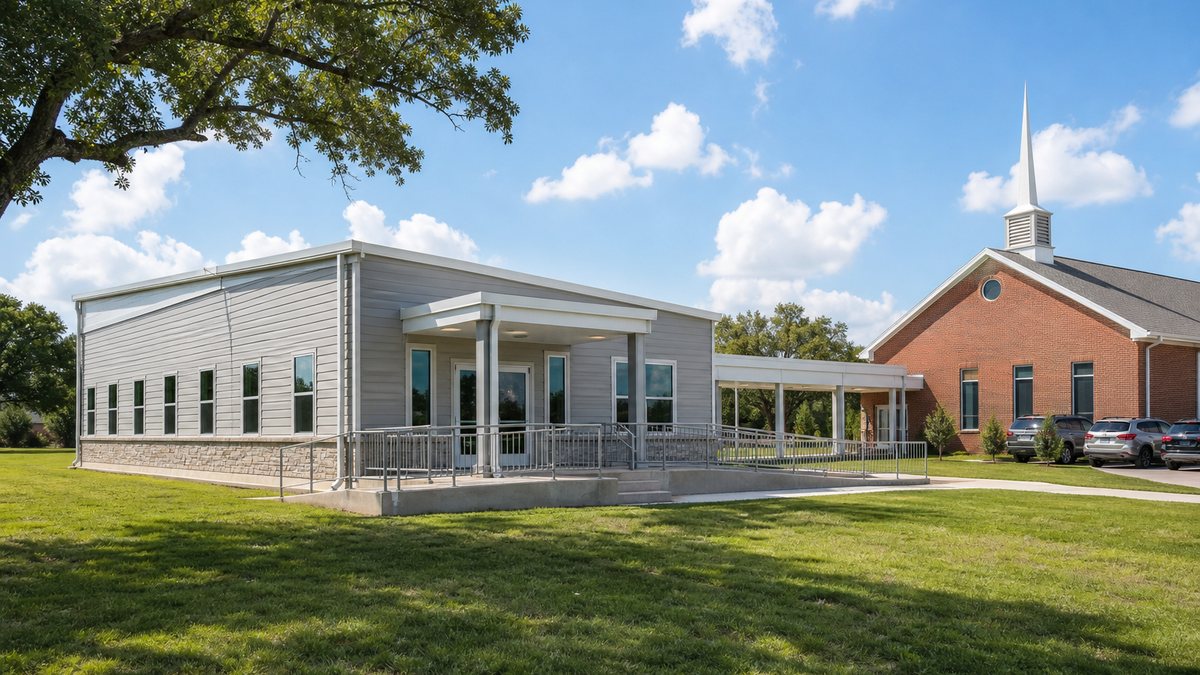
Modular church buildings in Dallas-Fort Worth give growing congregations a way to add fellowship halls, Sunday school and children's classrooms, youth rooms, offices, restrooms and even a temporary or permanent sanctuary without a multi-year construction campaign on the existing campus. The modules are built indoors in a plant under the Texas Department of Licensing and Regulation's Industrialized Housing and Buildings (IHB) program while your site work goes on in parallel, then they are delivered, set and finished on your property. For a church that is already out of space on Sunday morning, that parallel schedule and the reduced disruption to the campus are usually the main reasons to look at modular. Through our network of manufacturers, dealers and installers, we help churches across DFW and Texas compare lease, purchase, temporary and permanent options for each campus; our modular church buildings page shows the building types.
Quick answer: A modular church building in Texas is a commercial industrialized building: it is built to TDLR-approved plans and carries a TDLR decal, while your city or county handles zoning, the site plan, the foundation, utility connections, fire access and the final inspection. Most church projects are fellowship halls, children's and education wings, offices and restroom buildings, with sanctuaries less common but possible. The building must be approved for the right occupancy: places of religious worship are generally assembly occupancies, and an office-approved trailer is not automatically approved for a classroom or a worship gathering. Federal law (RLUIPA) requires cities to treat religious assemblies at least as well as comparable nonreligious assemblies. The Texas Accessibility Standards apply to church buildings, with a narrow exemption for the area used primarily for religious ritual. Costs depend on size, finish level, restrooms, foundation and site work, so get quotes for your actual campus.
This guide is for churches, ministries, faith-based schools and denominational offices in North Texas. It is general information, not legal, tax or code advice; your building official, architect or engineer and your own advisors have the final word. If you already know the address and the space you need, request a free quote and we'll send back options that fit your campus.
Why churches in North Texas look at modular
DFW has been adding residents and new neighborhoods for years, especially in Collin, Denton, Rockwall, Kaufman, Ellis, Johnson and Parker counties. New subdivisions bring young families, and a church that planted in a strip center or a school cafeteria can outgrow its space quickly. Established congregations face the opposite problem: a campus built decades ago with too few classrooms, restrooms that are not accessible, or a fellowship hall that needs to be closed for renovation. Modular buildings fit both situations for a few reasons.
- Schedule. Because the building is built in a factory while the site is prepared, the overall timeline can be shorter than conventional construction. McKinsey & Company's 2019 report on modular construction found that modular approaches can accelerate project timelines by 20 to 50 percent, depending on the project. Your timeline still depends on zoning, permitting, site work and the manufacturer's schedule.
- Less disruption on the campus. Most of the noise, dust and weather delays stay at the plant. Set day is usually the loud day; finish work on site is far smaller than a site-built project.
- Lease or buy. Many church needs are temporary: overflow space during a capital campaign, classrooms while a building is renovated, or a worship space while a permanent sanctuary is designed. Leasing a building for a defined period lets the church match the building to the plan.
- Phasing. A modular classroom or office building can be added in phases as giving and attendance grow, and a leased building can be returned or swapped as needs change.
- Relocation. Buildings designed to be moved between commercial sites can follow a church plant to a permanent campus, subject to the inspection rules described below.
What churches build with modular
The most common church projects are support buildings rather than sanctuaries. These are the building types we see requested most, and what each usually involves.
| Building | Typical use | What to plan for |
|---|---|---|
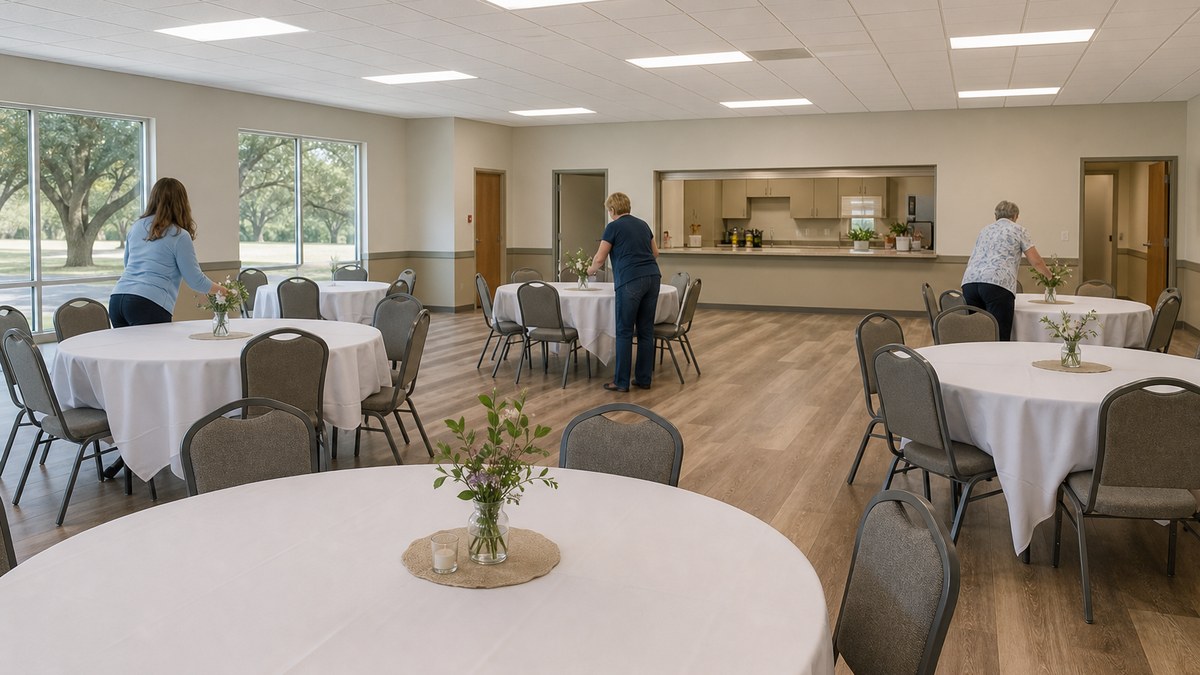
| Fellowship hall | Meals, receptions, Wednesday nights, community events, funerals and weddings | Open span, assembly occupancy, restrooms, serving kitchen or warming kitchen, exits and fire access |
| Children's and nursery wing | Sunday school, nursery, check-in, kids' worship | Child-height fixtures, check-in area, visibility, restrooms close by, secure entry |
| Education and classroom building | Adult classes, Bible study, small groups, faith-based school classrooms | Classroom count and sizes, occupancy that matches the use, covered walkway to the main building |
| Youth building | Student ministry, game rooms, worship nights | Larger open room, sound, durable finishes, separate restrooms |
| Church offices | Pastoral and administrative offices, counseling rooms, workroom | Private offices, sound control, accessible restroom, IT closet |
| Restroom building | Added or accessible restrooms near the sanctuary or fields | Water, sewer or septic connections, accessible stalls, location on the accessible route |
| Temporary sanctuary | Worship space while a permanent building is designed and built | Large clear span, assembly occupancy, parking, exits, sound and AV, how long it will stay |
| Permanent worship building | A smaller congregation's primary worship space or a chapel | Permanent foundation, exterior finishes that fit the campus, design review, long-term ownership |
See our modular buildings for churches and religious organizations page for building types, and our modular classrooms, restroom buildings, mobile offices and modular kitchens pages for each building family.
Zoning and land use: how Texas cities treat church buildings
Zoning is where most church projects in DFW succeed or stall, and it is decided before anyone orders a building. Two layers of law apply.
State law on industrialized buildings
TDLR's guidance says cities may require local permits, review plans, inspect the foundation and on-site work, and enforce zoning, setbacks and subdivision rules for industrialized buildings, but may not require amendments to the state's mandatory building codes for them. TDLR's commercial building guide adds that cities enforce zoning uniformly and cannot confine industrialized buildings to manufactured-housing zones or bar them from city limits, although they may prohibit them in residentially zoned areas. Many DFW churches sit in residential zoning districts, so that last point matters: check how your city's ordinance treats a modular building on a church lot in a residential district before you plan the project.
Federal law on religious land use
The Religious Land Use and Institutionalized Persons Act (RLUIPA) is a federal law that applies to land use decisions about religious assemblies and institutions. The U.S. Department of Justice's 2018 statement on its land use provisions summarizes four protections:
- Substantial burden. A government may not impose a land use regulation that substantially burdens religious exercise unless it uses the least restrictive means of furthering a compelling interest.
- Equal terms. Religious assemblies must be treated at least as well as comparable nonreligious assemblies, such as clubs, community centers or auditoriums.
- Nondiscrimination. Land use rules may not discriminate on the basis of religion or religious denomination.
- Exclusion and unreasonable limitation. A government may not totally exclude religious assemblies from its jurisdiction or unreasonably limit them.
RLUIPA does not exempt churches from neutral, generally applicable rules such as setbacks, parking, fire lanes or building codes. In practice it means your church should be reviewed by the same standards as a comparable nonreligious assembly use. If a city's response seems inconsistent with that, talk with an attorney who handles religious land use; this guide is not legal advice.
Tip: Ask the planning department three questions early: Is a church, and a church accessory building, allowed by right in our zoning district or does it need a specific use permit? Does the ordinance treat a temporary modular building differently from a permanent one, and is there a time limit? Do commercial or institutional design standards (masonry, roof form, screening) apply to accessory buildings on our lot? The answers decide the building, the foundation and the exterior finish.
Temporary vs. permanent on a church campus
Many DFW zoning ordinances allow temporary buildings for a limited period, often tied to a building permit for a permanent structure or to a specific approval. A church leasing classrooms during a renovation usually fits that pattern. A building that will stay indefinitely is reviewed as a permanent accessory building or primary building, with permanent site improvements. Decide which you are asking for, because the time limit, foundation type and exterior expectations follow from it.
Codes and occupancy: the detail that trips up church projects
Every commercial industrialized building in Texas is built to plans approved for a specific use. The data plate lists the occupancy group and construction type, and building officials compare it with how you will actually use the building. This is where a church can get into trouble with a used trailer or a building bought for one purpose and used for another.
- Worship and fellowship are assembly uses. The International Building Code, the model code behind the mandatory codes TDLR applies, lists places of religious worship in assembly Group A-3. A fellowship hall used for dinners and events is also an assembly space.
- Classrooms in a church building. The model code says accessory religious educational rooms and religious auditoriums with occupant loads of less than 100 per room or space are not considered separate occupancies. A weekday school, preschool or daycare is a different use and is reviewed differently.
- Small assembly spaces. The model code classifies a building or tenant space used for assembly with an occupant load of less than 50 as business Group B. Your designer will confirm how this applies to your building.
- Office-approved buildings. A trailer approved as an office is not automatically approved for a Sunday school, a youth room or a worship service. Ask the supplier which occupancy the building is approved for before you sign.
Occupancy drives exits, door hardware, restroom counts, fire alarm and sprinkler requirements, separation between buildings and fire department access. A design professional and the manufacturer's design review agency work these out; your job is to describe how the building will really be used, including the biggest event of the year, not just a typical Sunday.
Accessibility: TAS, the ADA and the religious-ritual exemption
Accessibility rules for churches are often misunderstood, so it is worth being precise.
- The ADA. Title III of the federal Americans with Disabilities Act exempts religious organizations and entities they control, including places of worship. That exemption does not cover every situation; for example, space a church leases to a separate school or daycare may be treated differently, and employment rules can apply to larger church employers.
- Texas Accessibility Standards. Texas is different from the federal rule. TDLR's Architectural Barriers rules (16 TAC Chapter 68) exempt only an area within a building of a religious organization used primarily for religious ritual, as designated by the owner and clearly marked on plans submitted for review. The exemption does not cover parking, accessible routes, walkways, restrooms, entrances, drinking fountains or exits.
- Registration and review. According to TDLR, projects with a total estimated construction cost of $50,000 or more must be registered and reviewed by a Registered Accessibility Specialist, and a local building official can require registration for smaller projects.
For a modular fellowship hall or classroom building, that means the ramp or level entry, the route from parking to the door, accessible parking, door hardware and the restrooms all need to meet TAS. Those items are mostly built at the site, so they belong in the site plan from the first sketch. Accessible restrooms are also one of the most common reasons churches add a modular restroom building in the first place.
Property tax: what to ask your appraisal district
Texas Tax Code Section 11.20 provides a property tax exemption for religious organizations. In general terms, real property owned by a qualifying religious organization that is used primarily as a place of regular religious worship and is reasonably necessary for worship can be exempt, along with certain clergy residences and personal property used for worship. The organization must apply to the appraisal district and receive the exemption; it is not automatic.
Questions to settle before you buy or lease:
- Will the church own the building, or lease it from a dealer or leasing company? Ownership and how the building is classified (real or personal property, on a permanent or temporary foundation) can affect how it is taxed.
- Will the building be used for worship and related activities, or partly for other purposes such as a leased school or a business?
- Does the church's existing exemption need to be updated when a new building is added?
Talk with your appraisal district and a tax advisor. We don't give tax advice; this section only explains what to ask.
Children's ministry and church-run schools
Children's spaces bring their own questions, and the answers depend on what the program actually is.
- Sunday school and care during services. Texas Human Resources Code Section 42.041 exempts from child-care licensing certain care provided while parents attend religious services or classes on the premises, as long as the facility does not advertise as a child-care facility and tells parents it is not state-licensed. It also exempts short summer religious instruction programs of up to two weeks conducted by a religious organization.
- Weekday preschool, Mother's Day Out or daycare. These programs may need state child-care licensing, which brings its own building and space requirements. Check with Texas Health and Human Services Child Care Regulation before you design the building.
- Faith-based schools. A school operating on the church campus is generally an educational use with its own code path. See our modular buildings for schools and portable classrooms guide.
For any children's building, plan the check-in point, sightlines, restroom location, secure entry and a covered walkway to the main building. Those are design choices, not code minimums, but they decide how the building works on Sunday morning.
Foundations and the site: building on DFW clay
Much of North Texas sits on expansive clay soils that swell when wet and shrink in drought, and the Texas heat, spring storms and hail add their own demands. The site work is where a church's budget and schedule are most often decided.
- Foundation design. TDLR guidance calls for foundations designed by a Texas-licensed engineer or architect for the site's soil and the local wind load. A temporary building may use a temporary foundation system where the city allows it; a permanent building needs a permanent foundation.
- Soil information. A geotechnical report helps the engineer choose the foundation and is especially useful on an older campus where fill and drainage are unknown.
- Drainage. Keep water away from the building and from under the floor. Gutters, downspouts and grading matter on clay.
- Ramps, decks and walkways. Build them on their own footings and check slopes and landings as the ground moves, so the accessible route stays compliant.
- Utilities. Water, sewer or septic, power and data usually come from the existing campus. Find out early whether the existing service has capacity for a new restroom building or kitchen.
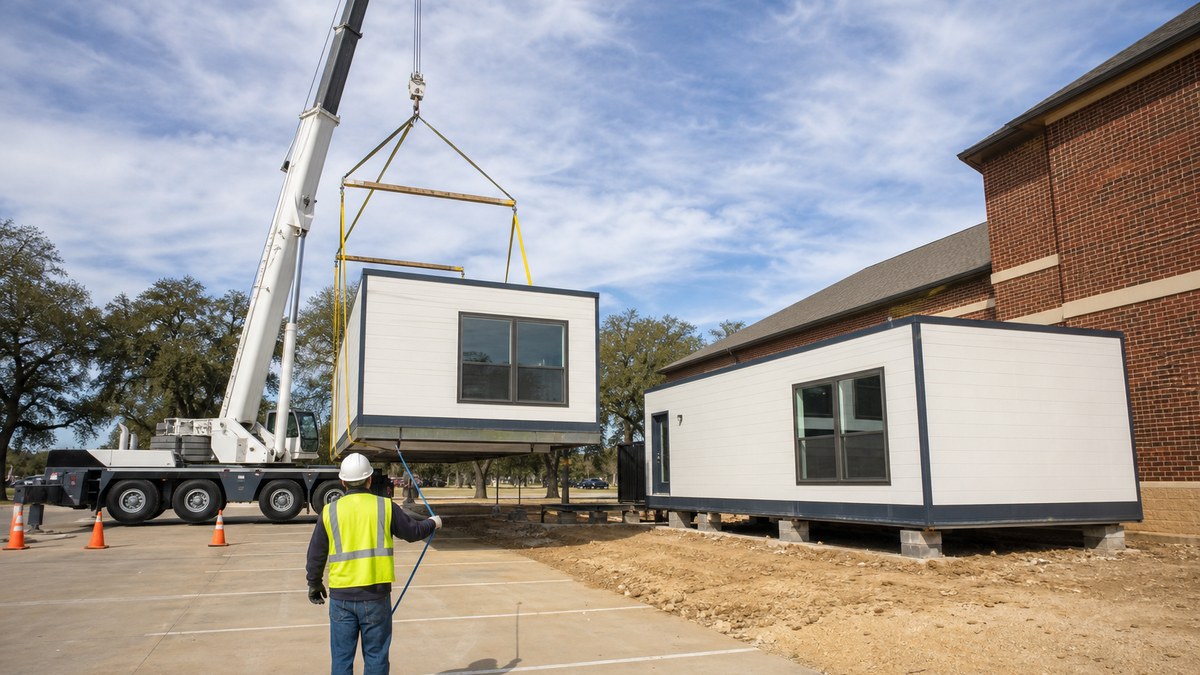
- Delivery and crane access. Modules are wide loads. Overhead lines, parking lot islands, trees and soft ground after rain can all affect set day, so walk the route with the installer.
Our modular buildings page explains how foundation type follows temporary vs. permanent use, and our sales, leasing, delivery and relocation services page explains how a project is coordinated through our network.
Moving a used or relocated building onto a church campus
A used building can be a good fit for a church on a budget, but there are two rules to know. First, TDLR's guidance says a site inspection is required for each installation of an industrialized building designed to be moved between commercial sites, and the exemptions that apply to some small or non-public buildings do not apply when the building is used as a school or a place of religious worship. Second, a building with an approved decal that has not been altered can be recognized as compliant even after code editions change, but an altered building must be recertified with an alteration decal before a city has to accept it.
Before buying a used building, confirm that every module still has its TDLR decal, that the data plate is legible, that the approved occupancy matches your use and that nobody has altered the building without a new approval. Missing decals are a reason to walk away.
Lease, buy, temporary or permanent: choosing the path
| Path | Fits when | Trade-offs |
|---|---|---|
| Lease, temporary | Overflow space during a campaign or renovation, a church plant waiting on land, a defined number of months or years | No long-term asset; zoning time limits; standard floor plans and finishes |
| Buy, relocatable | Long-term need that may move with the church, phased growth | Ownership and maintenance; site inspection on each move for worship or school use |
| Buy, permanent | A building that will be part of the campus for decades | Permanent foundation; exterior design standards; full site improvements |
| Custom modular | A fellowship hall, sanctuary or children's wing designed around your ministry | Longer design and approval phase; more choices to make; see our custom modular buildings |
Cost factors (no guesswork prices)
We don't publish prices because church projects vary widely and quotes from manufacturers and dealers change with the market. These are the factors that move the number most:
- Size and number of modules. More floor area and more modules mean more building, more transport and more set work.
- Clear span. Fellowship halls and sanctuaries need open rooms without interior columns, which affects the structural design.
- Occupancy. Assembly and educational uses bring requirements for exits, fire protection and restrooms that an office does not.
- Restrooms and kitchens. Plumbing-heavy modules, a serving kitchen or a commercial kitchen with a hood add cost and site utility work.
- Finish level. Interior finishes, ceiling height, acoustics, AV infrastructure, exterior siding or masonry skirting and roof style.
- Foundation and site work. Soil conditions, grading, drainage, ramps, decks, covered walkways, parking and utility extensions.
- Lease vs. purchase. Lease term, delivery and return, and whether the building is new or used.
- Distance and access. Transport distance from the plant or yard, route permits and crane access on your campus.
A useful way to compare quotes is to make sure each one covers the same scope: building, delivery, set, foundation, ramps and stairs, utility connections, skirting, and what the church or its contractor is expected to provide.
A step-by-step plan for a church building committee
- Define the ministry need. How many people, which rooms, which days, and how long. Include the largest event, not just a typical week.
- Pick the spot on the campus. Look at setbacks, parking, fire lanes, the accessible route, utilities and where the crane will go.
- Talk with the city. Confirm zoning, temporary vs. permanent rules, design standards and the permit path. Use a pre-application meeting if your city offers one.
- Decide lease or buy, temporary or permanent. Match the path to the plan and the budget.
- Request quotes with the same scope. Share the floor plan you have in mind, the occupancy, restrooms, kitchen, foundation expectations and the target date.
- Design and approvals. The manufacturer's TDLR-approved plans, a sealed foundation design, the site plan, accessibility registration where required and your city's building permit.
- Site work and plant build in parallel. Foundation, utilities, grading and walkways at the church while the modules are built.
- Delivery, set and finish. Set, tie-down or attachment, utility connections, ramps, skirting and interior finish work.
- Inspections and certificate of occupancy. Final inspections and, where required, the certificate of occupancy before the first service or class.
- Update the tax exemption and insurance. Talk with your appraisal district and insurer about the new building.
Our modular building permits guide walks through the permit steps in more detail.
Five DFW church scenarios
1. Church plant in Prosper or Celina
A young church meeting in a school in Prosper or Celina buys land and needs worship space before it can fund a permanent sanctuary. A leased, relocatable building with an assembly occupancy, a temporary use approval from the city and enough parking gets the congregation on its own property while the permanent building is designed.
2. Children's wing in Frisco or McKinney
An established church in Frisco or McKinney runs out of nursery and preschool-age rooms on Sunday morning. A modular children's building next to the main entrance with a check-in area, child-height restrooms and a covered walkway adds classrooms without closing the existing building.
3. Fellowship hall in Fort Worth during a renovation
A congregation in Fort Worth closes its fellowship hall for a two-year renovation. A leased modular hall with a serving kitchen keeps Wednesday night meals and receptions going, then goes back when the renovation is done.
4. Accessible restrooms in Waxahachie
A historic church near Waxahachie has restrooms that cannot be made accessible without major demolition. A permanent modular restroom building on the accessible route from the parking lot solves the problem with less disruption to the original building.
5. Offices and classrooms in Arlington
A multi-ethnic church in Arlington holds services in several languages and needs more classrooms and offices for staff. A two-module office and classroom building, approved for the right occupancy, frees up space in the main building for worship.
We help churches with the same kinds of projects in Dallas, Plano, Denton, Allen, Wylie, Rockwall, Forney, Little Elm, Keller, Mansfield, Burleson, Weatherford, Houston and San Antonio, and across our Texas service area.
Common mistakes churches make
- Buying a building before checking zoning. A building the city will not allow on your lot, or allows only for a short time, changes the plan.
- Using an office trailer for classes or worship. The occupancy on the data plate has to match the use.
- Assuming the ADA exemption covers everything. In Texas, TAS still applies to everything outside the area used primarily for religious ritual, including restrooms, entrances and the route from parking.
- Planning for an average Sunday. Exits, restrooms and parking should handle Easter, Christmas and the biggest community event.
- Leaving out the site work. Foundation, ramps, walkways, drainage and utilities are a large part of the project and of the quote comparison.
- Forgetting the appraisal district. A new building can affect the church's property tax exemption; ask before move-in.
- Skipping the covered walkway. In North Texas heat and spring storms, a covered connection between buildings is one of the most appreciated details.
Checklist before you request quotes
- Church name, campus address and whether it is inside city limits or on county land.
- Zoning district, and anything the city has already told you about temporary or accessory buildings.
- The ministry use: fellowship hall, classrooms, children's wing, youth, offices, restrooms or worship.
- Expected attendance in the building on a typical week and at the largest event.
- Rooms needed, restrooms and any kitchen or serving area.
- Lease or buy, how long you need it, and whether it might move later.
- Utilities near the location: water, sewer or septic, power, data.
- Any survey, site plan or soil report you already have.
- Target move-in date and any board or congregational vote dates.
Send that through our quote form or call (702) 738-2218, and we'll return options through our network of manufacturers, dealers and installers, matched to your campus and your ministry.
Frequently asked questions
Can a church use a modular building in Texas?
Yes. Churches across Texas use modular buildings for fellowship halls, classrooms, children's wings, offices, restrooms and worship space. The building is approved and inspected in the plant under TDLR's Industrialized Housing and Buildings program, and the city or county regulates zoning, the site, the foundation and the final inspection.
Can a modular building be used as a sanctuary?
Yes, if it is designed and approved for an assembly occupancy and the site meets zoning, parking, exit and fire access requirements. Many churches use a modular building as a temporary sanctuary while a permanent one is designed, and smaller congregations sometimes use one as their permanent worship space.
Can we use an office trailer for Sunday school?
Not automatically. Every commercial modular building in Texas is approved for a specific occupancy, which is shown on its data plate. A building approved as an office may not be approved for classes or worship, so confirm the approved occupancy with the supplier and your building official before you use it.
Does the ADA apply to church buildings?
Title III of the ADA exempts religious organizations and places of worship. Texas is different: the Texas Accessibility Standards apply to church buildings, with an exemption only for the area used primarily for religious ritual. Parking, accessible routes, entrances, restrooms, drinking fountains and exits are not exempt.
Can a Texas city refuse a modular church building?
A city can apply its zoning, setback, parking, design and code rules, and TDLR guidance says cities may prohibit industrialized buildings in residentially zoned areas. Under federal RLUIPA, a city must treat religious assemblies at least as well as comparable nonreligious assemblies and may not substantially burden religious exercise without a compelling reason. Talk with the planning department early, and with an attorney if a dispute arises.
Is a modular church building exempt from property tax?
It may be. Texas Tax Code Section 11.20 exempts property owned by a qualifying religious organization that is used primarily as a place of regular religious worship and is reasonably necessary for worship, but the church must apply to the appraisal district. Ownership, use and whether the building is leased can affect the answer, so ask your appraisal district and a tax advisor.
Do we need a child-care license for a modular children's building?
It depends on the program, not the building. Texas law exempts certain care provided while parents attend services or classes on the premises and short summer religious instruction programs. A weekday preschool or daycare may need a state license from Texas Health and Human Services, which brings its own space requirements.
Can we move a used modular building onto our church property?
Yes, with care. TDLR requires a site inspection for each installation of a relocatable industrialized building used as a place of religious worship or a school. Check that every module has its TDLR decal, that the data plate is legible and that the building has not been altered without an alteration decal.
What foundation does a modular church building need in North Texas?
A Texas-licensed engineer or architect designs the foundation for your site's soil and wind load. A temporary building may use a temporary foundation system where the city allows it, while a permanent building needs a permanent foundation. On DFW's expansive clay, drainage and separate footings for ramps and decks are important.
How much does a modular church building cost?
It depends on size, clear span, occupancy, restrooms and kitchen, finish level, foundation and site work, lease or purchase, and delivery distance. We don't publish prices; request a quote with your campus address and the rooms you need, and compare quotes that cover the same scope. Call (702) 738-2218.
Related
Also see our education buildings, commercial modular buildings, food service buildings, all building types and industries we serve.
Sources
- U.S. Department of Justice, Statement on the Land Use Provisions of the Religious Land Use and Institutionalized Persons Act (2018).
- Texas Department of Licensing and Regulation, IHB building site inspections and local permits.
- Texas Department of Licensing and Regulation, Industrialized Buildings: Commercial Building Guide.
- Texas Department of Licensing and Regulation, Architectural Barriers FAQ; 16 TAC Chapter 68, §68.30 exemptions (places used primarily for religious rituals).
- Texas Human Resources Code, §42.041, child-care licensing exemptions.
- Texas Tax Code §11.20, religious organizations exemption (summary: Freeman Law).
- International Code Council, International Building Code, Chapter 3 (Group A-3, Sections 303.1.1 and 303.1.4).
- McKinsey & Company, Modular construction: From projects to products (2019).
This guide is general information, not legal, tax, engineering or code advice. Zoning, permit, accessibility, licensing and tax rules are set by each city, county and state agency and change over time; confirm with your building official, appraisal district, TDLR, Texas HHSC and licensed professionals before you buy, lease or build.