Home › Guides › Construction site restrooms in Dallas
Job site facilities guide
Construction site restrooms & restroom trailers in Dallas-Fort Worth: OSHA counts, options and site planning
A practical guide for general contractors, superintendents, plant managers and event planners in Dallas-Fort Worth: how many toilets OSHA requires on a job site, when portable toilets are enough, when a restroom or shower trailer pays off, when a permanent modular restroom building makes sense, and what to plan for water, waste, power, permits and Texas weather.
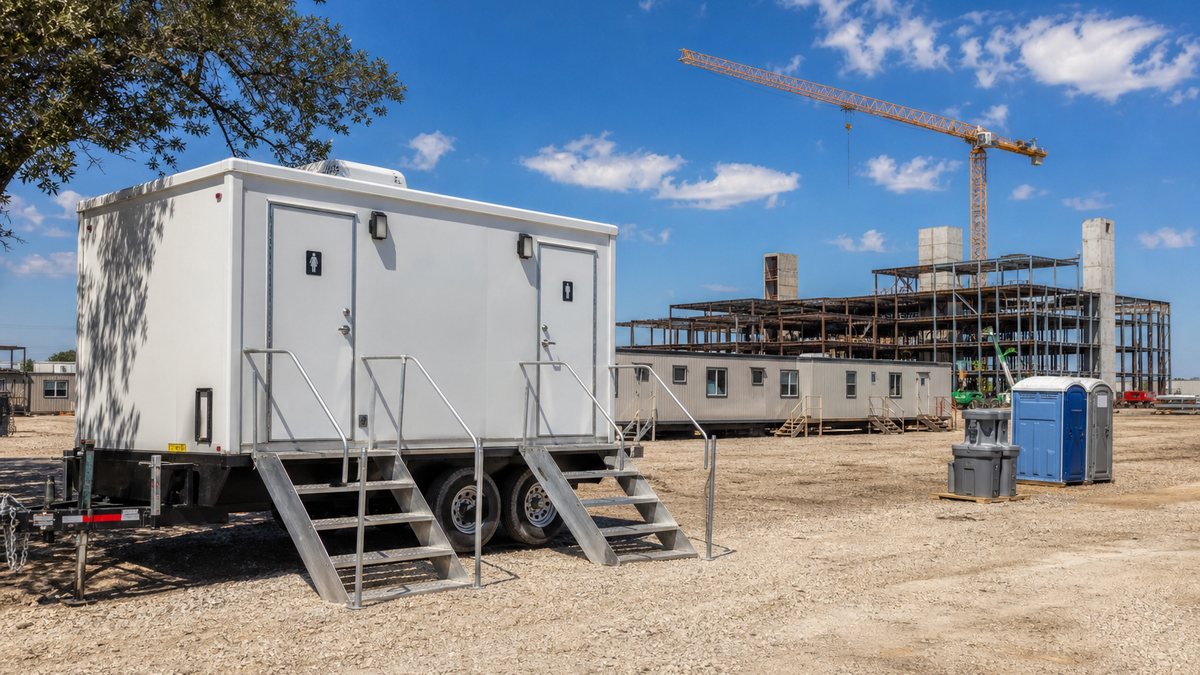
Construction site restrooms in Dallas range from a single portable toilet with a hand-wash station to multi-station restroom trailers, shower trailers and permanent modular restroom buildings. Federal OSHA rules set the minimum: at least one toilet for a crew of 20 or fewer, then one toilet seat and one urinal for every 40 workers, and one per 50 once a site reaches 200 or more workers, all kept in sanitary condition with hand-washing available. Above that minimum, the right choice depends on crew size, how long the project runs, whether water and sewer are on site and how hot or cold the work will be. Through our network of manufacturers, dealers and installers, we help contractors, plants, schools and event organizers across Dallas-Fort Worth and Texas compare restroom trailers, modular restroom buildings and the job site offices that go with them.
Quick answer: Under OSHA 29 CFR 1926.51, a construction site needs 1 toilet for 20 or fewer workers, 1 toilet seat and 1 urinal per 40 workers at 20 or more, and 1 toilet seat and 1 urinal per 50 workers at 200 or more. Toilets only count if they are clean and close enough to reach quickly, and workers need hand-washing with soap and water. Portable toilets cover short or small jobs; restroom trailers make sense for long projects, big crews, plant turnarounds and office compounds; shower trailers serve camps and dirty work; and modular restroom buildings are the permanent option for parks, schools, sports fields and yards. In Texas, chemical toilet waste must be hauled by a TCEQ-registered transporter, and city permits usually apply when you connect water, sewer or power. Cost depends on the unit, the term, servicing and the site, so request quotes on the same spec.
This guide is general information, not legal or safety advice. OSHA, your safety team, your local building official and the supplier have the final word on your site. If you already know the crew size, dates and address, request a free quote and we'll return restroom options alongside any mobile offices or storage containers you need.
Your options: from portable toilets to permanent restroom buildings
"Job site restroom" covers several very different products. Knowing the differences makes quotes easier to compare.
| Option | What it is | Typical fit |
|---|---|---|
| Portable toilets | Single-user chemical toilets with a holding tank, often with a urinal inside; serviced on a schedule | Small crews, short jobs, early site work, scattered work areas |
| Accessible portable toilets | Larger single-user units with a ground-level entry, turning space and grab bars | Public areas, events, sites with workers or visitors who need them |
| Hand-wash stations | Stand-alone sinks with fresh-water and gray-water tanks, soap and towels | Paired with portable toilets to provide washing facilities |
| Restroom trailers | Towable units with flushing toilets, urinals, sinks, lighting and HVAC; separate men's and women's sides on most models | Long projects, large crews, office compounds, plant shutdowns, events |
| Shower and locker trailers | Multi-stall showers, often combined with restrooms and changing space | Crew camps, turnarounds, disaster response, hot and dirty work |
| Restrooms inside office trailers | A toilet and sink built into a single-wide or double-wide mobile office | Superintendent and owner offices; not a substitute for crew facilities on big sites |
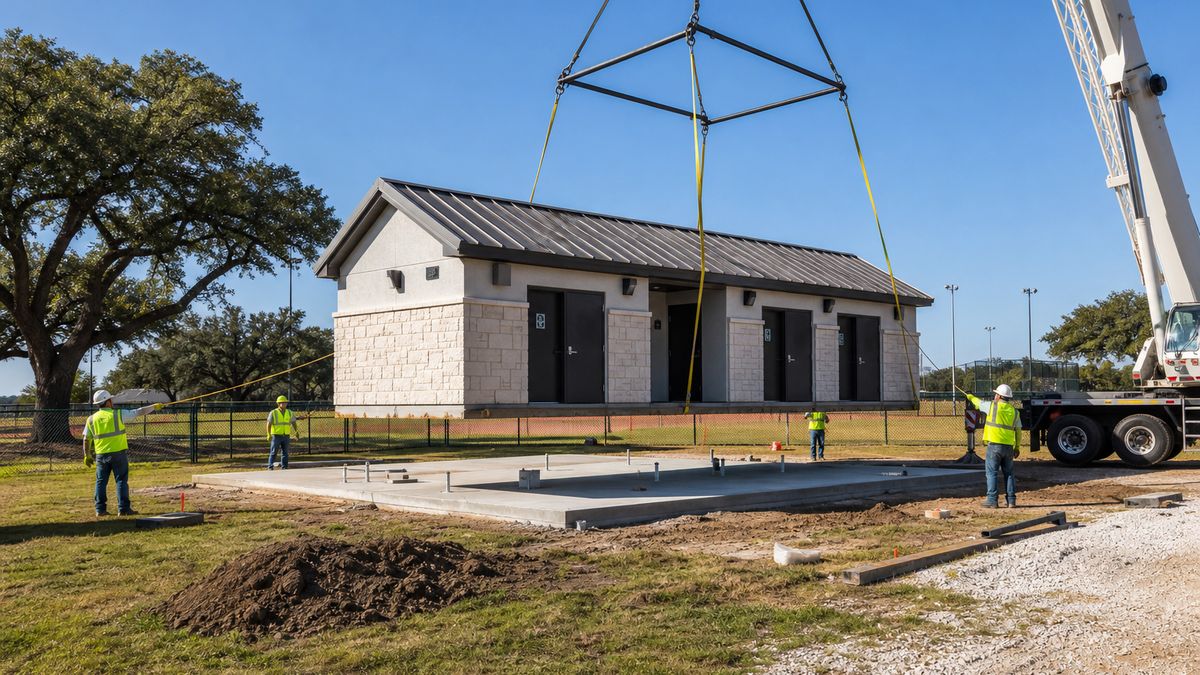
| Modular restroom buildings | Factory-built restroom or shower buildings, set on a foundation and connected to water and sewer | Parks, schools, sports complexes, yards, plants and any long-term or permanent need |
Most larger DFW job sites end up with a mix: restroom trailers near the office compound and parking, portable toilets spread across the work areas, and hand-wash stations wherever portable toilets go. See our construction trailers and job site buildings page for the full set of site facilities we can quote together.
What OSHA requires on a construction site
Federal OSHA's construction sanitation standard is 29 CFR 1926.51. Texas does not run its own OSHA state plan for private employers, so the federal rules apply on private job sites across Dallas-Fort Worth.
How many toilets: Table D-1
OSHA's Table D-1 sets the minimum number of toilet facilities by the number of employees on the site:
| Number of employees | Minimum toilet facilities (OSHA Table D-1) |
|---|---|
| 20 or fewer | 1 |
| 20 or more | 1 toilet seat and 1 urinal per 40 workers |
| 200 or more | 1 toilet seat and 1 urinal per 50 workers |
A few related points from the same standard:
- Temporary field conditions. Even under temporary field conditions, at least one toilet facility must be available.
- No sanitary sewer. Sites without a sanitary sewer must use privies (only where they will not contaminate ground or surface water), chemical toilets, recirculating toilets or combustion toilets, unless local codes prohibit them. In practice, that means portable toilets or self-contained restroom trailers with holding tanks on most new DFW sites.
- Mobile crews. The toilet requirements do not apply to mobile crews that have transportation readily available to nearby toilet facilities. OSHA's sanitation guidance describes prompt access for mobile workers as less than 10 minutes.
- Washing facilities. Lavatories are required, with hot and cold or tepid running water, hand soap and individual towels or air blowers, and washing facilities must be close to the work where workers handle paints, coatings, herbicides or other harmful contaminants. OSHA notes that waterless hand cleaner and rags are not adequate substitutes for soap and water.
- Potable water. An adequate supply of drinking water is required in all places of employment, which matters on 100-degree days in North Texas.
Clean and close enough to use
Counting units is not enough. In a 2006 interpretation letter, OSHA said a toilet in an unsanitary condition is unusable, so it is not "available" and does not count toward the Table D-1 minimum. The same letter points to the ANSI Z4.3 standard for nonsewered waste-disposal systems as a guide to servicing frequency, says a toilet used by up to 10 people should be serviced at least weekly, and says toilets that take too long to reach are not "provided" either. OSHA's restroom guidance adds that employers must let workers leave their work location to use a restroom, provide enough restrooms to prevent long lines and avoid restrictions, like locked doors, that cause extended delays.
Women on the job site
OSHA's general sanitation guidance calls for toilet rooms separate for each sex, and OSHA and the National Association of Women in Construction published Portable Toilet and Sanitation Best Practices for Women in Construction, which recommends clean, private, lockable facilities, hand-washing and supplies, and placement that does not force workers to walk long distances or wait. Restroom trailers with separate, lockable men's and women's sides, plus a few portable toilets reserved and signed for women, are a simple way to meet both the rule and the expectation on larger sites.
How many restrooms does your DFW site need?
Here is how the OSHA minimum works out for some common crew sizes, rounding up. Your safety plan, the general contractor's requirements, the owner's specifications and the layout of the site can all call for more.
| Peak workers on site | OSHA minimum (Table D-1) | Practical layout to consider |
|---|---|---|
| 15 | 1 toilet | 1 portable toilet plus a hand-wash station, or a restroom in the office trailer if it is close to the work |
| 60 | 2 toilet seats and 2 urinals | A small restroom trailer at the compound plus portable toilets near distant work areas |
| 120 | 3 toilet seats and 3 urinals | A mid-size restroom trailer and portable toilets spread across the site, with separate women's facilities |
| 250 | 5 toilet seats and 5 urinals | One or more larger restroom trailers, portable toilet banks by work zone, hand-wash stations and a servicing schedule sized for the crowd |
Tip: Size for the peak, not the average. On DFW commercial projects, headcount often doubles during MEP rough-in and finishes. Ask your supplier to add units for the peak months and remove them afterward rather than living with long lines. Walking distance matters too: on a big tilt-wall or data center site, one restroom trailer at the gate may be "too far" for crews at the back of the building.
Portable toilets vs. restroom trailers vs. modular restroom buildings
| Portable toilets | Restroom trailers | Modular restroom buildings | |
|---|---|---|---|
| Term | Days to months | Weeks to years | Long-term or permanent |
| Utilities | None; holding tank pumped on a schedule | Power plus fresh-water and waste tanks, or water and sewer hookups | Water, sewer or septic and power, like any building |
| Comfort | Basic | Flushing fixtures, sinks, lighting, heating and air conditioning | Full restroom finishes, often vandal-resistant |
| Placement | Anywhere a service truck can reach | Level pad, access for delivery and pumping | Foundation, utility connections and permits |
| Best for | Spread-out work, early phases, small crews | Office compounds, large crews, turnarounds, events | Parks, schools, sports fields, yards and plants |
Restroom trailers sit in the middle: more comfortable than portable toilets, still mobile, and able to move to the next project. Contractors who run several long projects at once in North Texas often lease or buy their own trailers and move them from site to site. When a restroom need is permanent, a modular restroom building is built in a factory, delivered finished and connected to site utilities, often with less time on site than a restroom built from the ground up.
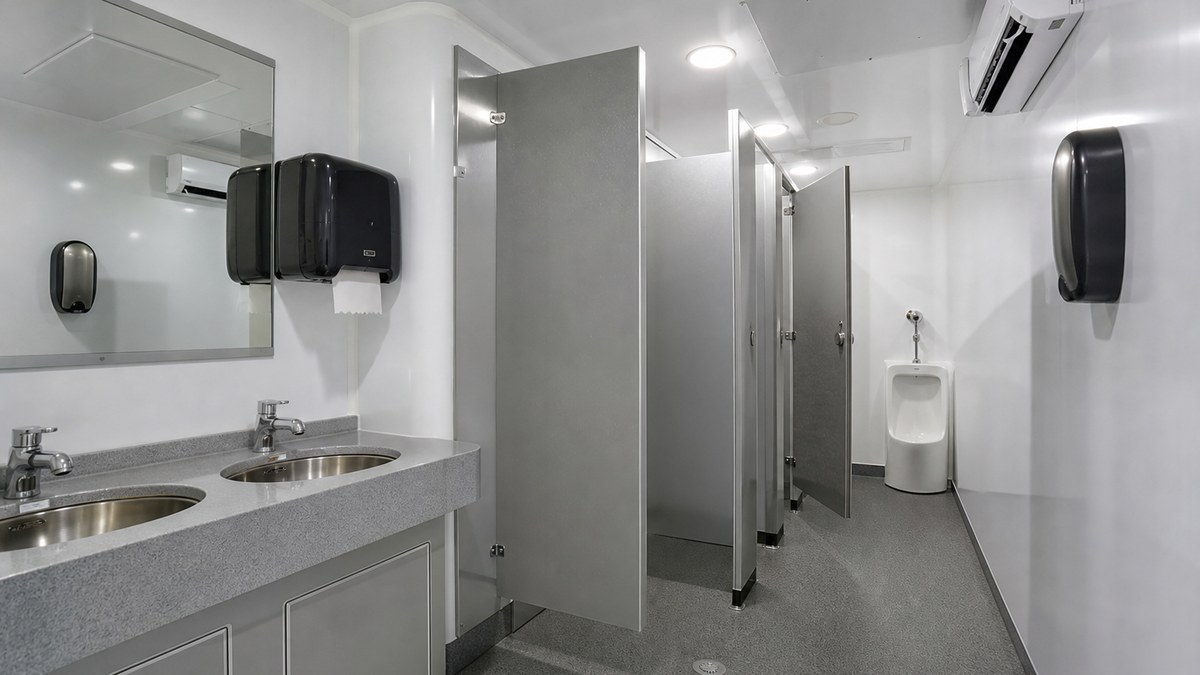
When restroom trailers make sense in Dallas-Fort Worth
Every site is different, but these situations usually justify trailers over a row of portable toilets alone:
- Long commercial and institutional projects. Hospitals, schools, mid-rise buildings and big industrial jobs that run a year or more. Better facilities help with crew comfort and retention, and many owners expect them.
- Data center and semiconductor construction. Large projects in places like Midlothian, Red Oak and Sherman bring hundreds of workers to one site, often with crew workforce housing, parking lots and badge-in gates. Restroom and shower trailers at the gate and in the parking areas, plus portable toilet banks by work zone, keep lines short.
- Plant shutdowns and turnarounds. Refinery, plant and warehouse projects add temporary crews for a few weeks. Restroom and shower trailers serve the surge without straining the plant's own restrooms. Our industrial modular buildings guide covers the in-plant offices and break rooms that usually go with them.
- Office compounds. When a job has a multi-unit mobile office complex for the owner, architect and contractor, a restroom trailer next to it is often simpler than building restrooms into each office.
- Facility renovations. Schools, offices and stadiums that close their own restrooms for remodeling need temporary restrooms for staff and visitors, often with accessible units.
- Events. Festivals, tournaments and outdoor events in places like Arlington, Fort Worth and Frisco use upscale restroom trailers for VIP and staff areas, alongside accessible portable units for the public.
Site planning: water, waste, power and placement
Restroom trailers and buildings need more planning than portable toilets. Settle these before the delivery date:
Water
Many restroom trailers can run from an onboard fresh-water tank that is refilled on a schedule, or from a hose connection to a hydrant or meter. If you connect to city water, expect a backflow device and possibly a temporary meter or plumbing permit, depending on the city. Make sure the water source is potable.
Waste
Self-contained trailers have waste holding tanks that are pumped by a service truck. Where a sanitary sewer is nearby, some trailers can connect directly, which usually requires a plumbing permit and inspection. In Texas, the Texas Commission on Environmental Quality (TCEQ) requires anyone transporting chemical toilet waste or domestic septage to register as a sludge transporter under 30 TAC Chapter 312, so ask your servicing company for its TCEQ registration.
Power
Lights, pumps, water heaters and air conditioning need power. Smaller trailers may run on a standard connection, while larger air-conditioned trailers need more capacity. Confirm the electrical requirements of the exact model with the supplier, and plan the temporary power with your electrician. A generator is an option where site power is not ready yet.
Placement
- A level, well-drained pad, ideally gravel, with room for steps, landings and a ramp where needed.
- Access for the delivery truck and, just as important, for the pump truck on every service visit.
- Short walking distance from work areas, parking and the office compound.
- Lighting for early starts and night shifts, and a clear, safe path to the door.
- Away from crane swing paths, laydown areas and traffic lanes.
Built for Texas weather
North Texas restrooms have to work through 100-degree summers, spring storms and the occasional hard freeze.
- Heat. Air-conditioned restroom trailers are far more usable in July and August than unshaded portable toilets. Place portable toilets in shade where you can, increase servicing in hot weather and keep drinking water and shade close by.
- Freeze. Water lines, tanks and fixtures can freeze in a hard freeze. Ask about heat tape, insulated skirting, tank heaters and a written drain-down plan for long outages. Portable toilets can also need winterizing.
- Wind and storms. Portable toilets tip over in high wind. Stake or strap them, and tie down restroom trailers as the supplier recommends. See our guide to hail, wind and heat for modular buildings.
- Clay soils. Expansive clay across much of North Texas swells when wet and shrinks when dry, which can throw trailers and buildings out of level and strain plumbing connections. Good drainage and proper blocking help; permanent buildings need an engineered foundation. Our North Texas clay foundations guide explains the options.
Permits, accessibility and codes in Texas
Temporary restroom trailers
Portable toilets usually do not need a building permit, but cities can regulate placement on public property and at events. Restroom trailers that connect to city water, sewer or power commonly need plumbing or electrical permits, and some cities want a temporary building or placement permit, especially for longer placements. Rules differ between Dallas, Fort Worth, the suburbs and unincorporated county land, so check early. Our modular building permits guide covers who regulates what in DFW.
Permanent modular restroom buildings
Texas regulates commercial modular buildings through the Texas Department of Licensing and Regulation's Industrialized Housing and Buildings (IHB) program, which approves the plans and inspects construction in the factory. The city or county still handles zoning, setbacks, the site permit, the foundation and utility connections, and TDLR says foundations are designed by a Texas-licensed engineer or architect. The number of fixtures in a permanent building comes from the plumbing and building codes, not from OSHA, so a public park restroom and a crew restroom at a plant may be sized very differently.
Accessibility
The U.S. Access Board's guide to the 2010 ADA Standards says that where single-user portable units are clustered, at least 5 percent at each cluster must be accessible, and that units on construction sites used only by construction personnel are exempt. Public areas, events, offices and permanent buildings are different: accessible units, routes, ramps and signage apply, and in Texas many projects are also reviewed under the Texas Accessibility Standards administered by TDLR. When in doubt, include at least one accessible unit and an accessible route to it.
Cost factors (no guesswork)
We don't publish prices because they swing widely with the market and the site. These are the factors that move a restroom quote:
| Factor | Why it matters |
|---|---|
| Type and number of units | Portable toilets, accessible units, hand-wash stations, restroom trailers by station count, shower trailers or a permanent building |
| Term | Weekly, monthly or multi-year; longer terms often lower the monthly cost, and buying can make sense for contractors who move units between projects |
| Servicing | Pumping, cleaning and restocking frequency, which rises with crew size and hot weather |
| Water and waste setup | Tanks and pump-outs versus hookups to water and sewer, plus any permits |
| Power | Site power versus a generator, and the load of air conditioning and water heaters |
| Delivery, setup and removal | Distance, access, steps, ramps, decks and tie-downs |
| Weather options | Freeze protection, skirting and anchoring |
| Finish level | Basic job site units versus upscale event trailers or vandal-resistant permanent buildings |
To compare apples to apples, give every supplier the same crew size, dates, address, utility situation and servicing expectations.
Three DFW scenarios
A 14-month medical office building in McKinney
The general contractor expects about 25 workers early on and 90 at the peak. The OSHA minimum at 90 workers is 3 toilet seats and 3 urinals. A practical plan: portable toilets and hand-wash stations during site work, then a restroom trailer next to the office compound once the slab is in and temporary power is available, with portable toilets moved closer to the building as it rises. See our McKinney modular buildings page.
A plant turnaround in Fort Worth
A three-week shutdown brings 150 contract workers. The plant's own restrooms are sized for the regular staff, so the contractor adds restroom and shower trailers near the contractor parking and break area, portable toilets near the units being worked and a servicing schedule that matches shift changes. In-plant offices and a break trailer complete the setup.
A city park restroom in Denton
A parks department needs a permanent restroom at a ballfield. A modular restroom building with accessible stalls, vandal-resistant fixtures and an optional concession window is designed under the IHB program, built in the factory while the site, foundation and utilities are prepared, then set and connected. See our Denton page and the Dallas page for nearby service.
Common mistakes to avoid
- Counting units instead of usable units. A full or dirty toilet doesn't count under OSHA's interpretation. Schedule servicing for the real crowd.
- Forgetting hand-washing. Every bank of portable toilets needs soap and water nearby.
- Putting the trailer where the pump truck can't reach. If the service truck can't get close, the tanks don't get pumped.
- No plan for women. Separate, lockable facilities avoid problems and complaints.
- Ignoring the freeze. One hard freeze can crack lines and take a restroom trailer out of service.
- Skipping permits for hookups. Water, sewer and power connections often need a permit and inspection.
Checklist before you request quotes
- Site address, and whether it is inside city limits or on county land.
- Peak and average number of workers, and the shift schedule.
- Project start date, peak months and expected finish.
- Whether water, sewer and power are available, and where.
- Number of work zones and walking distances from the work to the restrooms.
- Need for separate women's facilities, accessible units and showers.
- Any owner, general contractor or safety-plan requirements beyond OSHA.
- Delivery access and a level spot for each trailer.
- Whether you also need office trailers, break rooms or storage.
Send that through our quote form or call (702) 738-2218, and we'll return options through our network of manufacturers, dealers and installers. Working outside Dallas? See all cities we serve across DFW and Texas.
Frequently asked questions
How many portable toilets does OSHA require on a construction site?
Under OSHA 29 CFR 1926.51 Table D-1, a site with 20 or fewer employees needs at least one toilet facility. At 20 or more employees, the minimum is one toilet seat and one urinal per 40 workers, and at 200 or more it is one toilet seat and one urinal per 50 workers. Toilets must be kept sanitary to count.
How often should job site portable toilets be serviced?
OSHA does not set a fixed schedule in the standard, but its 2006 interpretation letter points to ANSI Z4.3 as a guide and says a toilet used by up to 10 people should be serviced at least once a week. Larger crews, hot weather and heavy use call for more frequent service. A dirty or full toilet does not count toward the OSHA minimum.
Do construction sites need hand-washing stations?
Yes. OSHA requires lavatories with running water, hand soap and towels or air dryers, and washing facilities near the work where employees handle paints, coatings, herbicides or other harmful substances. Waterless hand cleaner is not an adequate substitute for soap and water.
Can I rent a restroom trailer for a construction site in Dallas?
Yes. Restroom and shower trailers are available for short-term rental, longer leases or purchase for job sites across Dallas-Fort Worth, depending on availability. Send your crew size, dates and site details and we will return options through our network of dealers and installers.
Does a restroom trailer need water and sewer hookups?
Not always. Many restroom trailers run on onboard fresh-water and waste tanks that are refilled and pumped on a schedule, plus a power connection or generator. Trailers can also connect to water and sewer where available, which usually needs a plumbing permit and inspection.
Do I need a permit for a restroom trailer in Dallas-Fort Worth?
Portable toilets usually do not need a building permit, but restroom trailers that connect to city water, sewer or power commonly need plumbing or electrical permits, and some cities require a temporary building or placement permit. Rules vary between cities and counties, so check with the local building department before delivery.
Do construction site restrooms have to be ADA accessible?
The U.S. Access Board's guide to the 2010 ADA Standards says portable units on construction sites used only by construction personnel are exempt, while clustered single-user portable units elsewhere need at least 5 percent accessible at each cluster. Public areas, events, offices and permanent buildings must meet accessibility requirements, including the Texas Accessibility Standards where they apply.
Who can haul portable toilet waste in Texas?
The Texas Commission on Environmental Quality requires anyone transporting chemical toilet waste or domestic septage to register as a sludge transporter under 30 Texas Administrative Code Chapter 312. Ask your servicing company for its TCEQ registration.
What is the difference between a restroom trailer and a modular restroom building?
A restroom trailer is mobile and temporary: it is towed in, set on a level pad and can move to the next site. A modular restroom building is a permanent building made in a factory under Texas's industrialized building program, set on a foundation and connected to water, sewer and power, like a site-built restroom.
How do restroom trailers handle Texas heat and freezes?
Most restroom trailers have air conditioning and heat, which makes them far more usable than unshaded portable toilets in summer. For winter, ask about heat tape, tank heaters, insulated skirting and a drain-down plan so water lines and tanks don't freeze during a hard freeze.
Related
Also see our construction trailers, mobile offices, storage containers, workforce housing, industrial and manufacturing pages, all building types and industries we serve.
Sources
- U.S. Occupational Safety and Health Administration, 29 CFR 1926.51, Sanitation (Table D-1, toilets, washing facilities, potable water).
- OSHA, Standard interpretation: whether toilets at a construction jobsite must be in a sanitary condition (May 17, 2006).
- OSHA, Restrooms and Sanitation Requirements.
- OSHA and National Association of Women in Construction, Portable Toilet and Sanitation Best Practices for Women in Construction.
- U.S. Access Board, Guide to the ADA Standards, Chapter 6: Toilet Rooms.
- Texas Commission on Environmental Quality, Sludge transporter registration (30 TAC Chapter 312, Subchapter G).
- Texas Department of Licensing and Regulation, IHB building site inspections and local permits.
- Texas Department of Licensing and Regulation, Industrialized Buildings: Commercial Building Guide.
This guide is general information, not legal, safety or code advice. OSHA requirements, accessibility rules and local permits change over time and depend on the site; confirm with your safety professional, your local building official and the supplier before you rent, buy or install.