Home › Guides › Modular buildings for data center construction in DFW
Mission-critical job site guide
Modular buildings for data center construction sites in Dallas-Fort Worth: offices, security, crew facilities and site planning
A practical guide for general contractors, owner's reps, developers and trade partners building data centers in Midlothian, Red Oak, Ellis County, Fort Worth and across North Texas: which temporary and modular buildings a hyperscale or colocation job needs, how to size and phase them, what Texas rules apply, and how to plan around heat, clay soils and site security.
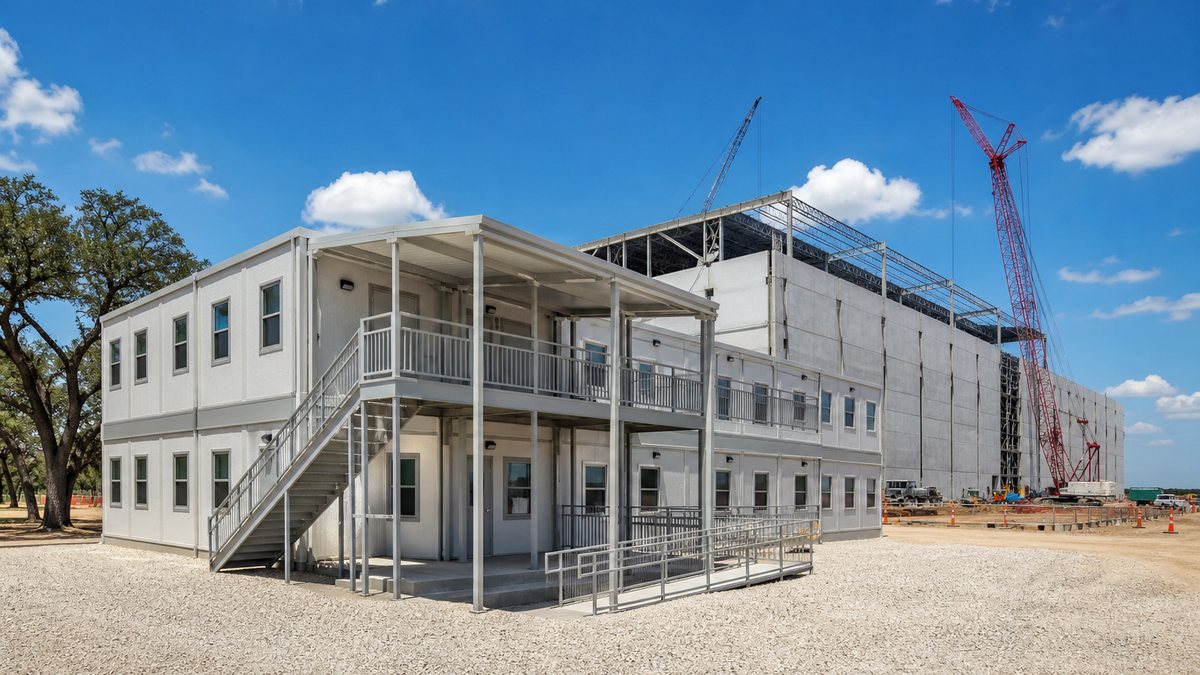
Modular buildings for data center construction in Dallas-Fort Worth include the job site office complexes, badge-in security buildings, crew break and lunch buildings, restroom and shower trailers, commissioning offices, storage buildings and sometimes workforce housing that a hyperscale or colocation project needs for two years or more. Data center jobs differ from a typical commercial build: crews often run into the hundreds or thousands, the owner usually requires controlled access, and the schedule pushes for every building to be ready on day one. Through our network of manufacturers, dealers and installers, we help contractors and developers across DFW and Texas plan, quote and phase the construction trailers and job site buildings these projects depend on.
Quick answer: A typical DFW data center job site uses five groups of modular buildings: (1) a field office complex for the owner, general contractor, design team and commissioning agents, often double-wide or multi-module buildings joined into one complex; (2) security and badging buildings at each gate; (3) crew facilities: break and lunch buildings, restroom and shower trailers and hand-wash stations sized to the peak headcount (OSHA 29 CFR 1926.51 sets the toilet minimum); (4) storage and laydown: storage containers and climate-controlled buildings for sensitive equipment; and sometimes (5) workforce housing on remote sites. Plan them as a phased campus, not a list of trailers: size for the peak, place them where trucks and cranes won't conflict, budget power and water early, and confirm the city or county permits for occupied buildings. Cost depends on size, term, finishes, site work and utilities, so get quotes on one written spec.
This guide is general information, not legal, safety or code advice. Your owner's requirements, safety plan, local building official and the supplier have the final word. If you already have a site address, dates and headcount, request a free quote and we will return options for the whole compound.
Why DFW data center sites need so much temporary space
North Texas is one of the busiest data center construction markets in the country. CBRE's North America Data Center Trends H1 2026 report says that 95 percent of the more than 765 MW under construction in Dallas-Fort Worth has already been preleased, and that developers have another 3.7 GW of greenfield development planned but not yet started. The same report notes that several large new projects are being developed in the Fort Worth area, outside the traditional core around downtown Dallas, and that limits on large power loads are pushing demand toward sites under 75 MW.
The construction pipeline follows land and power. Ellis County, south of Dallas, has become one of the most active areas: in December 2025, The Real Deal reported a filing for an $880 million, one-story Google data center building in Midlothian, with construction scheduled to start in January 2026 and finish by February 2027. Projects in and around Midlothian, Red Oak, Waxahachie, Ennis, Lancaster, Fort Worth and Sherman all share the same pattern: a greenfield site, a long schedule, a very large crew and an owner that expects a clean, secure, well-run job.
Power is the other driver. The Texas Tribune reported in June 2026 that about 70 percent of the large-load projects asking to connect to the ERCOT grid are data centers, according to ERCOT, and that the grid operator was moving to evaluate large loads in batches. For contractors, that means more projects, more phases and more pressure to mobilize quickly once a project is funded and powered.
The modular buildings a data center job usually needs
Every project is different, but most hyperscale and colocation sites in DFW use some combination of the following:
| Building | What it does | Typical configuration |
|---|---|---|
| Field office complex | Offices for the owner's team, general contractor, design team, inspectors and commissioning agents; conference and plan rooms | Several double-wide or multi-section mobile offices joined into one complex, sometimes two stories |
| Trade partner offices | Separate offices for electrical, mechanical, controls and other major subcontractors | Single-wide or double-wide office trailers in a trade village |
| Security and badging | Gate control, badge issuance, safety orientation check-in, vehicle and delivery screening | Guard booths at each gate plus a larger badging building near parking |
| Safety orientation and training | New-hire orientation, toolbox talks, training sessions | Open-plan modular classroom-style building |
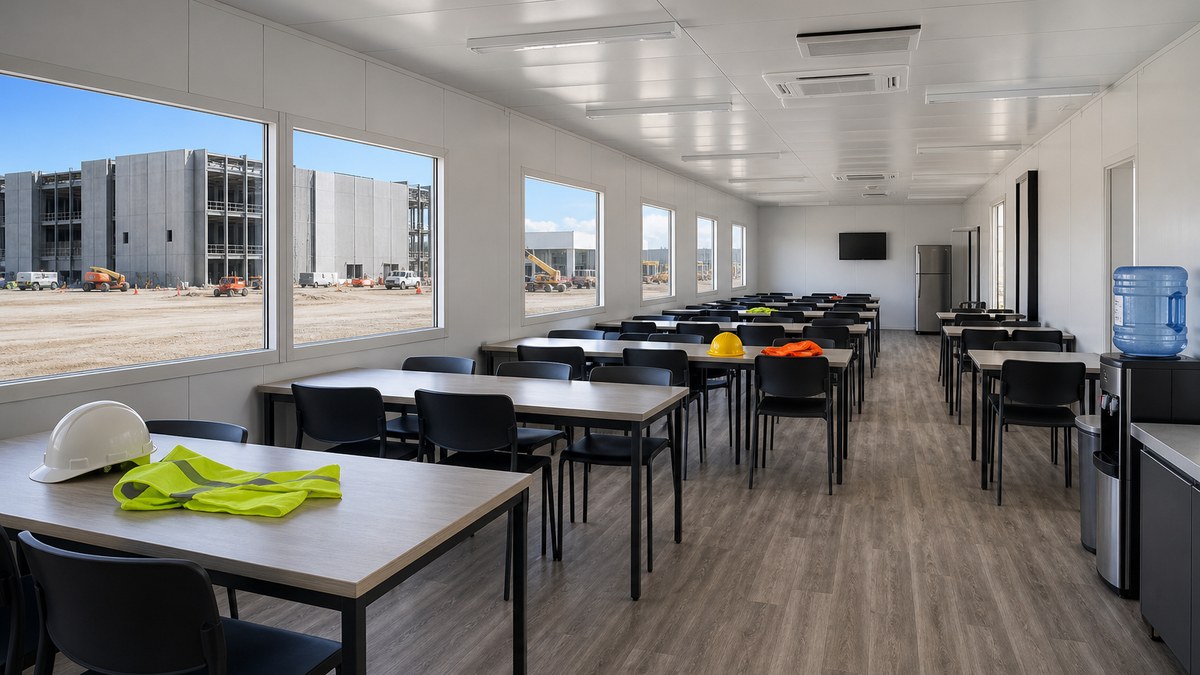
| Break and lunch buildings | Air-conditioned space for crews to eat, cool down and rest | Large open modular buildings near parking or the work areas |
| Restroom and shower trailers | Sanitation for large crews, often with separate women's facilities | Multi-station restroom trailers plus portable toilets and hand-wash stations by work zone |
| Storage and climate-controlled storage | Tools, materials and sensitive equipment that must stay dry and cool | Storage containers, office-and-storage combos and insulated buildings |
| First aid and medical | On-site first aid and nurse station | Small modular clinic-style office |
| Workforce housing | Lodging where local housing and commutes can't support the crew | Dormitory-style modular housing units |
Grouping these into one coordinated order usually makes delivery, setup, utilities and removal simpler than sourcing each building separately. Our sales, lease, rental, delivery and relocation services page explains the purchase and lease options.
Plan the compound like a small campus
On a large data center job, the temporary facilities compound can be its own small campus. Treating it that way avoids the most common problems: offices in the wrong place, gates that back up traffic and buildings that have to move halfway through the job.
Phase it with the project
- Mobilization and site work. A small office, a guard booth, portable toilets and hand-wash stations, and storage containers. Crews are small and the site is mostly earthwork and underground utilities.
- Structure and shell. The main office complex, the badging building, the first break buildings and restroom trailers. Headcount climbs quickly once steel and tilt-wall or precast work starts.
- Electrical, mechanical and fit-out (peak). This is usually the largest crew on the job: electrical rooms, generators, cooling plants and white space all at once. Add trade offices, break buildings and restroom capacity for this phase.
- Commissioning and turnover. Crews shrink, but commissioning agents and the owner's operations team need quiet, secure offices close to the building.
- Next phase. Many campuses are built in phases. Placing the compound where it won't block phase two can save a full relocation later.
Placement
- Keep the office complex and badging building near the main gate and parking, outside the secure construction zone where possible, so visitors don't need escorts to reach the office.
- Put break buildings and restrooms within a short walk of the work areas, not only at the gate. On a site with buildings several hundred feet long, one location is rarely enough.
- Keep buildings out of crane swing paths, delivery routes, laydown yards and future building pads.
- Leave room for pump trucks, water trucks and fuel deliveries to reach every restroom and generator.
- Plan walkways, lighting and shade for 24-hour shifts.
Tip: Ask for a simple site plan of the compound before you order. Drawing the buildings, decks, ramps, parking, gates and utility routes on the civil plan usually exposes conflicts early, when they are still easy to fix.
Sizing for the peak headcount
Data center projects are known for large crews, and the facilities have to keep up. For sanitation, federal OSHA's construction standard (29 CFR 1926.51, Table D-1) sets the minimum: one toilet for 20 or fewer workers, one toilet seat and one urinal per 40 workers at 20 or more, and one toilet seat and one urinal per 50 workers at 200 or more, with hand-washing and drinking water required. Toilets only count if they are kept sanitary. Texas does not run an OSHA state plan for private employers, so the federal standard applies on private job sites in DFW. Our construction site restrooms guide works through the math in detail.
| Peak workers on site | OSHA toilet minimum (Table D-1) | Other facilities to plan |
|---|---|---|
| 150 | 4 toilet seats and 4 urinals | Break building near parking, restroom trailer at the compound, portable toilets by work zone |
| 400 | 8 toilet seats and 8 urinals | Several break buildings, multiple restroom trailers, a badging building that can process shift changes |
| 1,000 | 20 toilet seats and 20 urinals | Break and restroom clusters in each work zone, shower trailers if crews need them, a dedicated orientation building |
These are federal minimums, rounded up. Owner and general contractor requirements, women's facilities, walking distance and servicing frequency usually push the real number higher. Break space has no single federal formula, so size it with the general contractor around shift patterns, lunch staggering and Texas heat.
Security and access control
Data center owners usually treat the job site as a controlled site from day one. That changes the temporary facilities in a few ways:
- Badging and orientation buildings. A dedicated building near parking for ID checks, badge printing and safety orientation keeps the main office free for project work. Size the waiting area for the morning rush.
- Guard booths at each gate. Personnel gates and truck gates often need their own booths, with windows on the right sides, heating and air conditioning, and power for card readers and cameras. Our guard shacks and security booths guide covers sizes, options and codes.
- Turnstiles and fencing. Plan where turnstiles, fencing and lighting connect to each building so the compound can stay outside the secure zone.
- Owner and commissioning offices. Many owners want lockable, separate offices for their own team and for commissioning documentation.
Specific security requirements come from the owner and the general contractor, so share them with the supplier at the quote stage. Options such as window placement, door hardware and wiring for access control are easier to plan in the factory than to add in the field.
Power, water, data and waste
It is easy to forget that a data center job site has very little permanent power at the start. Temporary facilities often have to run before the utility service is energized.
Power
Office complexes, break buildings and restroom trailers all need power for lights, air conditioning and water heaters. Early in the job that often means generators; later, temporary service from the site's construction power. Get each building's electrical requirements from the supplier and coordinate them with the electrical contractor's temporary power plan. On large compounds, a planned distribution layout avoids extension-cord sprawl and tripped breakers in July.
Water and waste
Restroom trailers can run from fresh-water and waste tanks serviced by truck, or connect to water and sewer where available, which usually requires plumbing permits. Many greenfield data center sites have no sewer at the start, so tank-serviced units are common early on. In Texas, transporters of chemical toilet waste must register with the Texas Commission on Environmental Quality (TCEQ).
Data and communications
Field offices on data center jobs run heavy document and model workflows. Plan conduit or cabling between the office modules, a small network room or rack space in the complex, and how internet service reaches the compound before the permanent fiber is in.
Texas rules: permits, codes and accessibility
Texas regulates commercial modular buildings through the Texas Department of Licensing and Regulation's Industrialized Housing and Buildings (IHB) program, which approves designs and inspects construction in the factory. The city or county still handles zoning, setbacks, site permits, foundations and utility connections. A few points matter on data center jobs:
- Construction-site offices. TDLR's commercial building guide excludes construction-site offices that are not open to the public and are used by the builder, so many contractor field offices fall outside the IHB program. Buildings that are open to the public, or used for something other than the builder's own office, are treated differently. Confirm which category each building falls in.
- Local permits. Even when a building is exempt from IHB, the city or county may require a temporary building, placement, electrical or plumbing permit. Midlothian, Red Oak, Fort Worth and unincorporated Ellis County each have their own process, so check early. Our modular building permits guide explains who regulates what.
- Accessibility. Offices and buildings used by visitors, owners and the public need accessible routes, ramps and restrooms. In Texas, many projects are also reviewed under the Texas Accessibility Standards administered by TDLR. Plan ramps and landings into the compound layout from the start.
- Wind and anchoring. Temporary buildings still need proper tie-downs and anchoring for North Texas storms, as specified by the manufacturer and the local jurisdiction.
Built for North Texas sites
Many data center sites sit on open land south and west of Dallas, where heat, wind and clay soils all affect temporary buildings.
- Heat. The National Weather Service in Fort Worth reports that DFW's average first 100-degree day is July 1. Crews working long shifts need air-conditioned break space, shade and drinking water close to the work. Ask about higher-capacity HVAC, reflective roofs and covered decks.
- Expansive clay. Much of Ellis, Dallas and Tarrant counties has clay soils that swell and shrink with moisture. Good drainage, a compacted gravel pad and proper blocking help keep office complexes level over a multi-year job. Our North Texas clay foundations guide explains the options.
- Storms and hail. Spring storms bring wind and hail. Anchor buildings as specified, protect HVAC units where possible and keep a plan for securing loose items. See our hail, wind and heat guide.
- Mud and dust. Greenfield sites turn to mud after rain and dust in summer. Paved or gravel walkways, boot-wash stations and entry mats keep offices usable.
Rent, lease or buy?
Data center jobs often run long enough that the choice between renting, leasing and buying matters.
| Option | When it fits | What to watch |
|---|---|---|
| Rent | Short phases, peak-headcount surges, uncertain schedules | Monthly rates add up on multi-year jobs; check availability for large units |
| Lease | A multi-year project with a known end date | Term length, return conditions and who pays for relocation |
| Buy | Contractors running several data center jobs back to back, or owners who want a permanent operations or security building | Resale or redeployment plans, storage between jobs and moving costs |
Contractors that build several campuses in a row across North Texas sometimes buy their office complexes and move them from job to job. Owners sometimes keep a security or operations building after construction ends. Our mobile office trailer rental guide covers the rental side in more detail.
Cost factors (no guesswork)
We don't publish prices because they depend on the market, the building and the site. These are the factors that move a quote for a data center compound:
| Factor | Why it matters |
|---|---|
| Number, size and type of buildings | Single-wide offices versus multi-module complexes, two-story buildings, break buildings, restroom and shower trailers |
| Term and purchase option | Rent, lease or buy; length of each phase |
| Finishes and options | Interior layout, conference rooms, upgraded HVAC, security hardware, data cabling |
| Site preparation | Gravel pads, grading, drainage, blocking, anchoring |
| Decks, ramps and stairs | Accessible ramps, landings, covered decks, canopies |
| Utilities | Generators versus temporary service, water and sewer connections or tank servicing |
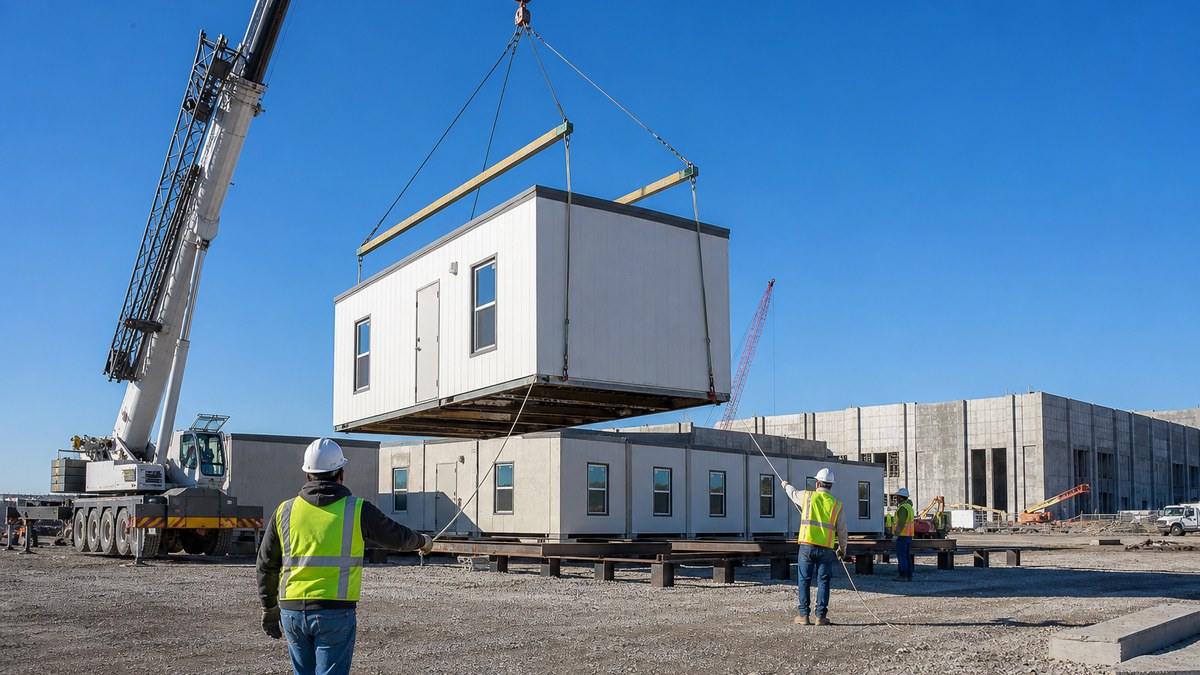
| Delivery, setup and removal | Distance, number of modules, crane needs, relocations between phases |
| Servicing | Restroom pumping and cleaning, water delivery, HVAC maintenance |
To compare quotes fairly, give every supplier the same site plan, phases, headcount, building list and utility assumptions.
Three DFW scenarios
A hyperscale campus in Ellis County
A general contractor starts a multi-building campus near Midlothian with a small site-work crew, expected to reach several hundred workers during electrical and mechanical work. The plan: a guard booth, two office trailers and portable toilets at mobilization; a multi-module office complex, badging building and restroom trailers once the shell starts; and break buildings plus extra restroom capacity next to each building for the peak. The compound sits beside the phase-two pad, not on it. See our Midlothian modular buildings page.
A colocation building in Fort Worth
A colocation developer builds a single data hall building on the west side of the metro. The owner wants a separate, lockable office for its operations team and commissioning agent. A double-wide office for the owner, a larger complex for the general contractor, a combination office-and-storage container for the electrical contractor and a small break building cover the job. See our Fort Worth page.
A permanent security building after construction
Once construction ends, an operator in Red Oak wants a permanent security and visitor building at the entrance. Because it is permanent and used beyond the builder's own office, it is designed through the IHB program, placed on an engineered foundation and permitted through the city. See our specialty buildings page for related options.
Common mistakes to avoid
- Sizing for the start, not the peak. Data center crews often multiply during electrical and mechanical work. Plan the add-ons before you need them.
- Putting the compound on a future pad. Relocating an office complex mid-project costs time and money.
- Ignoring the badging bottleneck. A small security building at a busy gate can back up traffic on public roads at shift change.
- Too few restrooms too far away. OSHA counts only toilets that are sanitary and reasonably close.
- Late power planning. Without a temporary power plan, buildings sit unusable or run on generators longer than budgeted.
- Skipping permit checks. Exempt from IHB does not mean exempt from local permits.
Checklist before you request quotes
- Site address, and whether it is inside city limits or in unincorporated county land.
- Project phases with start dates, peak headcount and expected finish.
- List of buildings: offices (by company), security, badging, orientation, break, restrooms, showers, storage, first aid, housing.
- Owner and general contractor requirements for security, finishes and data.
- Utility plan: generators or temporary service, water and sewer availability.
- Site plan showing gates, parking, laydown, crane paths and future phases.
- Accessibility needs for visitor and owner areas.
- Rent, lease or buy preference, and any plan to reuse buildings on later projects.
Send that through our quote form or call (702) 738-2218, and we'll return options through our network of manufacturers, dealers and installers. Building elsewhere in Texas? See all cities we serve, including Grand Prairie, Mansfield and Dallas.
Frequently asked questions
What modular buildings does a data center construction site need?
Most data center job sites use a field office complex for the owner, general contractor and design team, separate trade offices, security and badging buildings at the gates, break and lunch buildings, restroom and shower trailers, storage containers and sometimes workforce housing. The exact list depends on the project size, the owner's requirements and the phase of construction.
How many restrooms does a large data center job site need?
Federal OSHA 29 CFR 1926.51 Table D-1 requires one toilet for 20 or fewer workers, one toilet seat and one urinal per 40 workers at 20 or more, and one toilet seat and one urinal per 50 workers at 200 or more. A site with 1,000 workers needs at least 20 toilet seats and 20 urinals, kept sanitary and close to the work, and owners often require more.
Do construction office trailers need TDLR approval in Texas?
TDLR's commercial building guide excludes construction-site offices that are not open to the public and are used by the builder, so many contractor field offices fall outside the Industrialized Housing and Buildings program. Buildings open to the public or used for other purposes are treated differently. Local permits for placement, electrical or plumbing can still apply, so confirm with the city or county.
Can I lease a multi-unit modular office complex for a two-year data center project?
Yes. Multi-section office complexes are available to rent, lease or buy for long projects across Dallas-Fort Worth, subject to availability. Send the site address, dates, headcount and building list, and we will return options through our network of manufacturers, dealers and installers.
Where are data centers being built in Dallas-Fort Worth?
Construction is spread across the metro, with a lot of activity in Ellis County south of Dallas, including Midlothian and Red Oak, and in the Fort Worth area. CBRE reported in its H1 2026 report that more than 765 MW was under construction in DFW, 95 percent of it preleased, with another 3.7 GW of greenfield development planned.
What is a badging building on a construction site?
A badging building is a modular building near the site entrance where workers check in, show ID, receive site badges and often complete safety orientation. On data center projects it keeps access control and orientation out of the main field office and helps move large crews through the gate at shift change.
How do modular job site buildings handle Texas heat?
Modular offices and break buildings come with heating and air conditioning, and options such as higher-capacity HVAC, reflective roofs, insulated skirting and covered decks help in North Texas summers. The National Weather Service in Fort Worth puts DFW's average first 100-degree day at July 1, so plan cooled break space close to the work.
Should a contractor rent or buy job site offices for data center projects?
Renting suits short phases and uncertain schedules. Leasing suits a multi-year project with a known end date. Buying can make sense for contractors who build several data centers in a row and can move the buildings between jobs. Compare the total cost over the full term, including delivery, setup, relocation and removal.
What site preparation do modular office complexes need?
Most need a level, well-drained, compacted gravel pad, access for delivery trucks and sometimes a crane, blocking and anchoring as specified by the manufacturer, ramps and stairs, and power, water and data connections. On North Texas clay, drainage and proper blocking help keep the complex level over a long project.
Can the security building stay after the data center is finished?
Yes. Some operators keep or buy a permanent modular security or visitor building at the entrance. A permanent commercial building used beyond the builder's own office is typically designed through the TDLR Industrialized Housing and Buildings program, set on an engineered foundation and permitted through the city or county.
Related
Also see our industrial and commercial buildings pages, the industrial modular buildings guide, all building types and industries we serve.
Sources
- CBRE, North America Data Center Trends H1 2026: Dallas-Ft. Worth.
- The Texas Tribune, As data centers seek to tap Texas' energy, grid regulators are close to approving a new way of vetting requests (June 17, 2026).
- The Real Deal, Google to spend $880M on new data center outside Dallas (December 10, 2025).
- U.S. Occupational Safety and Health Administration, 29 CFR 1926.51, Sanitation.
- Texas Department of Licensing and Regulation, Industrialized Buildings: Commercial Building Guide.
- Texas Department of Licensing and Regulation, IHB building site inspections and local permits.
- Texas Commission on Environmental Quality, Sludge transporter registration.
- National Weather Service Fort Worth, DFW climate data.
This guide is general information, not legal, safety or code advice. Market figures are from the sources cited and change over time. OSHA requirements, permits and accessibility rules depend on the site; confirm with your safety professional, your local building official and the supplier before you rent, buy or install.