Home › Guides › Storage containers and modular storage buildings in DFW
Job site & yard guide
Storage containers and modular storage buildings in Dallas-Fort Worth: a 2026 guide for job sites and yards
How contractors, plants, schools, retailers and fleet yards across Dallas-Fort Worth choose between ground-level storage containers, office-and-storage combo units and modular storage buildings: sizes, security, heat and hail, OSHA storage rules for fuels and materials, Texas code questions, local permits, the cost factors to price and a checklist before you request quotes.
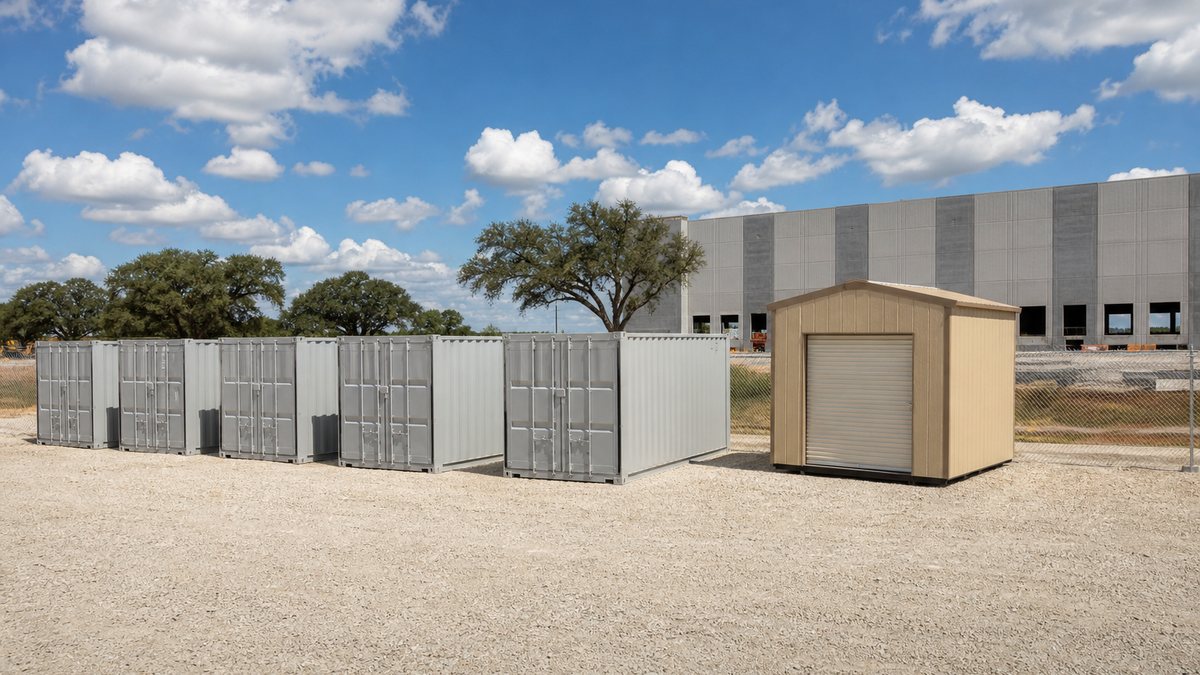
Storage containers and modular storage buildings give Dallas-Fort Worth job sites, plants and yards a lockable, weather-tight place to keep tools, materials, parts, records and equipment right where the work happens. The most common choice is a ground-level steel storage container in a 10-, 20- or 40-foot length. When a site needs more than a box, owners step up to an office-and-storage combo unit, a multi-container compound, or a modular storage building with shelving, power, lighting and climate control. Through our network of manufacturers, dealers and installers, we help contractors, facilities and fleets across DFW and Texas rent, lease or buy storage containers and modular storage buildings, delivered and placed on site.
Quick answer: For short projects and basic tool and material storage, rent a 20-foot or 40-foot ground-level storage container with a heavy-duty locking system. If a superintendent or parts clerk works next to the storage, use an office-and-storage combo unit. For long-term storage, inventory you need to find quickly, or items that can't take North Texas heat, consider a modular storage building with shelving, lighting, ventilation or air conditioning. Plan five things early: (1) what you are storing (flammable liquids and gases follow OSHA rules), (2) security and lighting, (3) heat, hail and drainage on clay soil, (4) delivery access and a level spot, and (5) local placement rules and permits. Ask for quotes on a delivered and placed basis so you compare the same scope.
This guide is general information, not legal, code, fire-safety or engineering advice. Your city or county building official, the fire marshal and the supplier have the final word. If you already know the site, the size and how long you need it, request a free quote or see our storage and office containers page.
Why DFW sites need more storage than ever
North Texas keeps building. Large logistics parks along I-20, I-35W, I-45 and Loop 9, data center campuses from Fort Worth to Ellis County, new schools in fast-growing districts and thousands of new homes each year all need materials, tools and equipment staged on site. The CBRE data center report for the first half of 2026 counted more than 765 megawatts of data center capacity under construction in the DFW market alone, and our data center construction guide explains why those sites need large temporary compounds.
Storage problems on a site usually look like one of these:
- Theft and vandalism. Tools, copper wire, small equipment and materials left in a pickup bed or under a tarp are easy targets on an open lot.
- Weather damage. Drywall, insulation, millwork, flooring, electrical gear and paper records don't survive a Texas downpour or a hailstorm in the open.
- Lost time. Crews spend part of each day walking to a truck or yard, or searching for parts, when storage isn't organized near the work.
- Safety. Loose materials and stored fuels in the wrong place create fire and trip hazards and can draw OSHA attention.
- Space inside the building. A plant or warehouse that is short on floor space can move overflow inventory, seasonal stock or records into a container or modular storage building outside.
Storage options compared
Sizes and features vary by manufacturer, dealer and fleet, and many units can be modified. These are the categories DFW buyers ask about most.
| Option | What it is | Best for | Watch for |
|---|---|---|---|
| Ground-level storage container | Steel box with cargo doors on one end, set directly on the ground or on blocking | Tools, materials, small equipment on job sites and yards | Heat buildup inside, condensation, a level and drained spot |
| High-cube container | Same as above with about a foot of extra height | Tall items, racking, bulky materials | Slightly taller doors and delivery clearance |
| Double-door or side-opening container | Doors on both ends or full-length side doors | Fast access to long or mixed inventory | Security of more door openings |
| Office-and-storage combo | A finished office at one end and storage at the other, in one unit | Superintendents, parts clerks, tool rooms, small yards | Office end needs power, HVAC and possibly local review |
| Multi-container compound | Several containers grouped, sometimes with a shared canopy roof between them | Large projects, trade partner storage, covered work areas | Layout, fire access lanes, canopy engineering |
| Modular storage building | Factory-built building with framed walls, doors, shelving, lighting and HVAC options | Long-term inventory, records, parts rooms, climate-sensitive storage | Foundation, permits and utility connections like any building |
| Specialty storage building | Prefabricated building designed for hazardous materials, chemicals or batteries | Plants, labs, utilities, fleet shops | Engineered to fire code; involve the fire marshal early |
If your crew also needs an office on the same site, see our mobile office trailer rental guide and mobile offices page. For a permanent plant or warehouse, our industrial modular buildings guide covers in-plant offices and outbuildings.
Container sizes: what fits
Storage containers are usually built from or based on ISO intermodal shipping containers. ISO 668 sets the nominal external sizes: about 8 feet wide, 8 feet 6 inches tall for a standard container and 9 feet 6 inches for a high-cube, in 20-foot and 40-foot lengths. Shorter 10-foot units are usually cut down or purpose-built for storage. Interior dimensions are a few inches smaller than the outside, and door openings are smaller still, so measure your largest item against the door, not the box.
| Length | Typical use | Site notes |
|---|---|---|
| 10 ft | Tools and small materials for one trade, a small retail or school site | Easiest to place on tight lots and parking areas |
| 20 ft | The most common job site size: tools, materials, small equipment, one or two trades | Fits most sites; check truck access and overhead lines |
| 40 ft | Large material packages, multiple trades, overflow inventory, records | Needs a long, straight approach for the delivery truck |
| Combo or modular | Office plus storage, organized parts rooms, climate control | Power, HVAC and sometimes a permit |
When in doubt, list what you will store and how often you need it. Items you need every day belong close to the door; seasonal or overflow items can go to the back or to a second unit.
Security: keep the stored value on site
Insurance industry groups such as the National Insurance Crime Bureau have reported for years that Texas sees a large share of the country's heavy equipment theft, and job site tool and material theft is a constant cost for DFW contractors. A storage container is only as secure as its doors, locks, lighting and placement:
- Locking system. Ask for a lock box that shields the padlock from bolt cutters and pry bars, and use a high-security padlock.
- Placement. Set the doors facing an area that is lit, visible and ideally covered by cameras, or facing another container or a wall so the doors can't be pried open easily after hours.
- Lighting and cameras. Exterior lights on the compound and a camera view of the doors help deter theft and help with claims.
- Fencing and gates. On larger sites, put storage inside the fenced compound with controlled gates. See our guard shacks and security booths guide for gate planning on logistics yards.
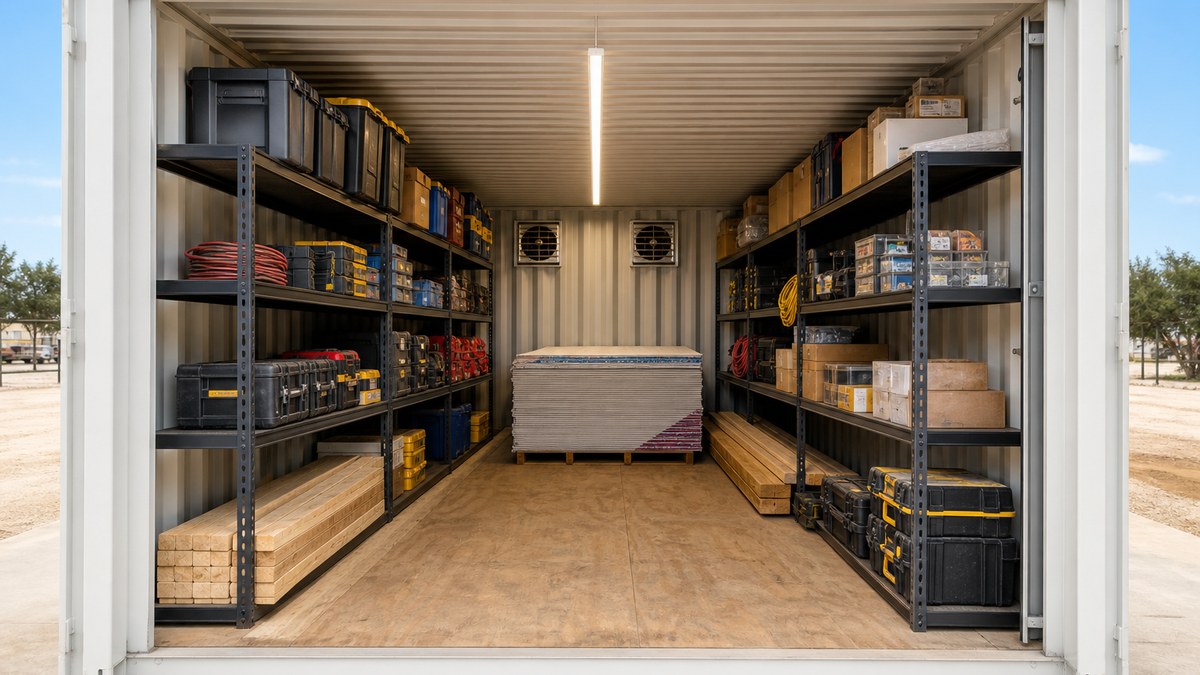
- Inventory control. Shelving, labeled bins and a sign-out sheet or app keep tools from walking off quietly.
- Alarm and power. Many units can be fitted with door sensors or alarms when power is available.
North Texas heat, hail and humidity
A closed steel box in a Texas summer gets hot inside. The National Weather Service office in Fort Worth reports that DFW's average first 100-degree day falls around July 1 and the last around late August. Heat is hard on adhesives, sealants, paint, batteries, electronics, vinyl and paper records. Plan for it:
- Ventilation. Ask for vents on both ends to let hot air and moisture escape.
- Light-colored exteriors and shade. A lighter color and a canopy or shade structure reduce heat gain.
- Insulation and air conditioning. For climate-sensitive stock, a container with insulation and a wall-mounted HVAC unit, or a modular storage building, is the better choice.
- Condensation. Temperature swings in spring and fall can cause condensation on the ceiling. Vents, moisture absorbers and pallets that keep goods off the floor help.
- Hail and wind. Steel containers handle hail better than many temporary structures, but canopies, rooftop units and any added roofing need to be specified for North Texas storms. Our hail, wind and heat guide covers what to ask for.
What you can store: OSHA rules for fuels and materials
Most storage containers hold ordinary tools and materials. Fuels, solvents, paints, adhesives and compressed gases are different. On construction sites, OSHA's fire protection standards in 29 CFR 1926 Subpart F apply, and Texas has no OSHA state plan for private employers, so the federal rules govern. Key points from the OSHA construction standards:
| OSHA rule | What it says |
|---|---|
| 1926.152(b)(1) | No more than 25 gallons of flammable or combustible liquids may be stored in a room outside an approved storage cabinet. |
| 1926.152(b)(3) | No more than 60 gallons of flammable or 120 gallons of combustible liquids in any one storage cabinet, and no more than three cabinets in a single storage area. |
| 1926.151(c)(5) | No combustible material may be stored outdoors within 10 feet of a building or structure. |
| 1926.151(c)(1)-(2) | Outdoor piles of combustible materials no higher than 20 feet, with driveways between piles at least 15 feet wide. |
| 1926.150(c)(1)(vi) | A fire extinguisher rated not less than 10B within 50 feet wherever more than 5 gallons of flammable or combustible liquids or 5 pounds of flammable gas are being used on the job site. |
| 1926.152(f)(3) | Flammable liquids may be used only where there are no open flames or other sources of ignition within 50 feet of the operation. |
What that means in practice: don't turn an ordinary storage container into a fuel and paint room. Keep flammable liquids in approved safety cans and cabinets, keep cylinders upright and secured in the place your safety plan calls for, and ask the supplier about purpose-built hazardous materials storage if you need more than cabinet quantities. Your city's fire code (most DFW cities use an edition of the International Fire Code with local amendments) and the fire marshal may add requirements. Also remember the 10-foot rule: a storage container full of combustible materials parked tight against a building can be a problem.
Plan the layout with fire access in mind. On larger sites, keep fire lanes, hydrants and fire department connections clear when you place containers, and keep containers away from exits and building openings. A fire marshal walk-through before delivery is cheaper than moving a row of containers later.
Texas code questions: container, building or neither?
Texas regulates commercial modular buildings through the Texas Department of Licensing and Regulation's (TDLR) Industrialized Housing and Buildings (IHB) program. TDLR's commercial building guide excludes some structures from the program, including a structure not on a permanent foundation that is either not open to the public or under 1,500 square feet (and not a school or place of worship), and construction-site buildings used by the builder that are not open to the public. A staff-only storage container sitting on blocking at a job site usually falls outside the IHB program, but confirm for your specific building.
It changes when storage becomes a building. A modular storage building on a permanent foundation, an office-and-storage combo that is used as an office, or a container converted into an occupied space can bring in the IHB program, the local building code and permits. The 2021 International Building Code added provisions for intermodal shipping containers repurposed as buildings or parts of buildings, and the International Code Council has published guidance on them. If you plan to cut openings, join containers, stack them or add people, treat it as a building project and get the design reviewed. TDLR also offers a site-inspection exemption for some small unoccupied buildings of 400 square feet or less on permanent foundations, such as equipment shelters, so ask the supplier how your building is classified.
Local permits and placement rules in DFW
Texas sets the rules for the building itself, but the city or county controls where it goes. Many DFW cities regulate portable storage containers in their zoning and building codes, with rules on placement, how long a container may stay, screening, setbacks and whether a permit is needed. Rules for a container at an active construction site with a building permit are often different from rules for a container at an operating business, a school or a home. Before delivery, check:
- Zoning. Whether outdoor storage or storage containers are allowed on the property, and for how long.
- Placement. Setbacks, fire lanes, parking spaces, sight lines at driveways and screening from the street.
- Permits. Whether a temporary storage permit, a building permit (for a modular storage building, combo office or modified container) or an electrical permit is required.
- Right-of-way. Containers on a street, sidewalk or alley usually need separate approval from the city.
- HOA or landlord rules. Commercial leases, business parks and planned developments often have their own restrictions.
Our modular building permits guide for DFW explains who regulates what, including sites outside city limits.
Site prep: level, drained and reachable
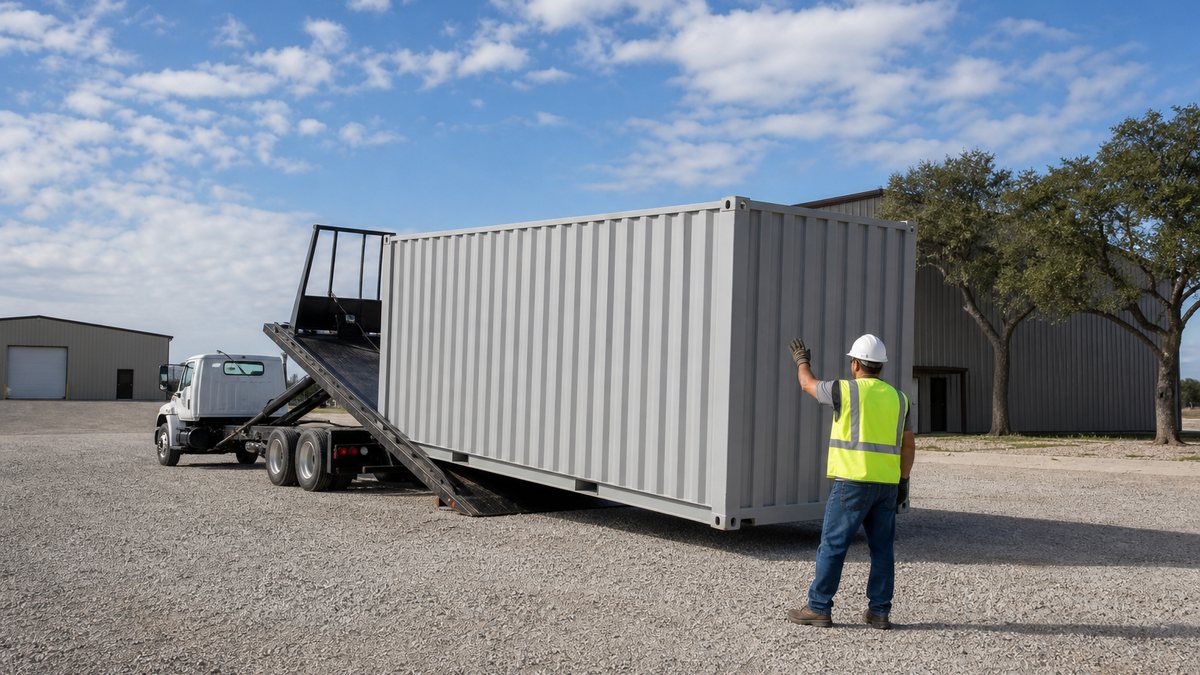
Most delivery problems come from the site, not the container. A storage container is usually delivered on a tilt-bed or roll-off truck that slides it off the back, so the truck needs a straight approach and room to pull forward as the unit slides off. Larger modular storage buildings may need a crane.
- Clearance. Check overhead power lines, tree limbs, gates and turns along the route and at the drop spot.
- A level, firm surface. A container that isn't level can rack, making doors hard to open and close. Gravel, compacted base, asphalt or concrete all work; set blocking under the corners on softer ground.
- Drainage on clay. Much of DFW sits on expansive clay that swells when wet and shrinks when dry. A spot where water ponds after a storm will soften, and the container can settle unevenly. Pick high ground or grade the spot to drain. See our North Texas clay foundations guide.
- Door direction. Decide which way the doors face before the truck arrives; turning a container on site is hard.
- Utilities. If you want lights, outlets, an alarm or HVAC, plan the power source and the electrical work.
Rent, lease or buy?
| Approach | Fits when | Think about |
|---|---|---|
| Rent | A single project with a defined schedule, or seasonal overflow | Monthly rent, delivery and pickup charges, damage waiver, minimum term |
| Lease | Multi-year needs at an operating plant, school or yard | Term, end-of-term options, maintenance |
| Buy new | Permanent storage or heavy customization | Purchase cost, modifications, lead time, resale |
| Buy used | Basic storage where appearance matters less | Condition of floor, doors, seals and rust; inspect before you buy |
Contractors who move from project to project often own a few containers and rent extra for peak periods. Our used vs. new modular buildings guide explains what to check on used buildings, and our sales, lease, rental and relocation services page covers purchase options.
Cost factors to price (no guesswork)
We don't publish prices because they depend on the unit, the term, the market and the site. These are the items that move a storage budget:
| Cost factor | Why it matters |
|---|---|
| Size and type | A 40-foot unit, high-cube, double-door, combo or modular building costs more than a basic 20-foot container |
| New, one-trip or used condition | Condition affects price, appearance and how well doors and seals work |
| Rental term | Monthly rates often drop on longer terms; short terms carry the full delivery and pickup cost |
| Delivery distance and access | Trucking, difficult access, a crane or a second trip all add cost |
| Modifications | Lock boxes, vents, shelving, lighting, outlets, insulation, HVAC, windows, man doors, ramps |
| Site preparation | Gravel pad, grading, blocking, drainage |
| Power and electrical work | Service, wiring and permits for lights, outlets and HVAC |
| Permits | Temporary storage, building or electrical permits where required |
| Damage waiver or insurance | Required by many rental agreements |
| Pickup and site restoration | Removing the unit and restoring the surface at the end |
To compare offers fairly, ask every supplier for the same scope: the unit, condition, modifications, delivery, placement, pickup and term.
The typical sequence
- List what you will store. Tools, materials, inventory, records, fuels or chemicals, and anything sensitive to heat or moisture.
- Choose the type and size. Container, combo or modular storage building, and how many.
- Pick the spot. Level, drained, reachable by the truck, clear of fire lanes and at least 10 feet from buildings if you will store combustible materials.
- Check local rules. Zoning, placement, permits and any HOA or landlord restrictions.
- Get quotes on the same scope. Unit, condition, modifications, delivery, pickup and term.
- Prepare the site. Gravel or base, blocking, drainage and power if needed.
- Deliver and place. Confirm door direction and level the unit.
- Set it up. Shelving, bins, lighting, locks, cameras and a fire extinguisher where your safety plan calls for one.
- Plan the exit. Schedule pickup or relocation when the project or season ends.
Five DFW scenarios
A general contractor on a logistics park in Lancaster
A contractor building a large distribution center south of Dallas needs storage for several trades. A compound of 40-foot containers inside the fenced laydown yard, with lock boxes, lights and a camera view, keeps materials secure, and a separate office-and-storage combo serves the superintendent. Flammable liquids stay in approved cabinets in a designated area that meets the OSHA limits. See our Lancaster modular buildings page.
A data center site in Midlothian
A large data center project in Ellis County runs for many months with many trade partners. The site plan groups containers by trade along a gravel lane, keeps fire lanes open and sets them back from the buildings under construction. Electrical contractors use insulated, air-conditioned containers for gear and cable that can't sit in summer heat. See our Midlothian page and the construction industry page.
A plant in Grand Prairie that ran out of floor space
A manufacturer needs room for packaging, spare parts and records. Instead of losing production floor, it places a modular storage building with shelving, lighting and air conditioning next to the plant on a permanent foundation, and plans the city permit and the electrical work like any small building. See our Grand Prairie page, plus industrial and manufacturing.
A school district in Denton during a renovation
A campus renovation needs a place to keep furniture, books and equipment for a semester. Several containers placed away from student drop-off routes, with the city's placement rules confirmed, hold everything until the work is done. See our Denton page and education.
A retailer in Fort Worth before the holidays
A store needs overflow storage for seasonal stock. A ground-level container at the back of the lot, with the landlord's approval and the city's rules on outdoor storage checked, adds space for a few months without a long lease. See our Fort Worth page and retail.
Common mistakes to avoid
- Storing fuels and solvents like ordinary materials. OSHA limits apply; use approved cans and cabinets and a designated area.
- Parking a container in a low spot. On clay, a soggy spot means settling, racked doors and wet goods.
- Forgetting the delivery truck. Overhead lines, tight turns and soft ground can stop a delivery.
- Ignoring heat. Adhesives, batteries, electronics and records can be damaged by summer temperatures in a closed box.
- Blocking fire lanes or exits. Containers belong out of fire access routes and away from building openings.
- Turning a container into an office without checking the rules. Adding people can make it a building with code, permit and accessibility questions.
- Comparing quotes with different scopes. One price may include delivery, pickup and lock boxes while another doesn't.
Checklist before you request quotes
- Site address, city or county, and the spot where the unit will sit.
- What you will store, including any fuels, chemicals or heat-sensitive items.
- Size and number of units, and whether you need an office end, shelving, lighting, vents or HVAC.
- Rent, lease or buy, and how long you will need it.
- Delivery access: truck route, overhead lines, gates, surface and door direction.
- Power available on site, and any security needs (lock boxes, lights, cameras, fencing).
- Any other buildings you need on the same site: offices, restrooms, break rooms or guard booths.
Send that through our quote form or call (702) 738-2218, and we'll return options through our network of manufacturers, dealers and installers. We serve job sites, plants and yards across North Texas and the state; see all cities we serve, including Dallas, Red Oak, Haltom City, Mesquite, Saginaw and Hutchins.
Frequently asked questions
What size storage container do I need for a job site?
A 20-foot container is the most common job site size and holds tools, materials and small equipment for one or two trades. A 40-foot container suits large material packages, several trades or overflow inventory. A 10-foot unit fits tight lots. Measure your largest item against the door opening, not just the box.
What is the difference between a storage container and a modular storage building?
A storage container is a steel box, usually based on an ISO shipping container, that is delivered and set on the ground. A modular storage building is a factory-built building with framed walls, doors, shelving, lighting and climate control options, usually set on a foundation and treated like any small building for code and permits.
Can I store gasoline, diesel or paint in a storage container?
Only within OSHA's limits and your local fire code. On construction sites, OSHA allows no more than 25 gallons of flammable or combustible liquids in a room outside an approved storage cabinet, and no more than 60 gallons of flammable or 120 gallons of combustible liquids in any one cabinet, with no more than three cabinets in one storage area. Use approved safety cans and cabinets and ask the fire marshal about anything more.
How far from a building should a storage container be?
OSHA's construction standard says no combustible material may be stored outdoors within 10 feet of a building or structure, so a container full of combustible materials should generally sit at least 10 feet away. Your city's fire code and the fire marshal may set other distances and require clear fire lanes.
Do I need a permit for a storage container in Dallas-Fort Worth?
It depends on the city, the property and how long the container stays. Many DFW cities regulate portable storage containers through zoning and building codes, with rules on placement, time limits, screening and permits. Containers at active construction sites with a building permit are often handled differently than containers at businesses or homes. Check with the city or county before delivery.
Is a storage container regulated by TDLR's modular building program?
Usually not when it is a staff-only storage unit on a temporary foundation. TDLR's commercial building guide excludes structures not on a permanent foundation that are not open to the public or are under 1,500 square feet, as well as construction-site buildings used by the builder. A modular storage building on a permanent foundation or a container converted into occupied space can be different, so confirm with the supplier and TDLR.
How do I keep a storage container cool in a Texas summer?
Use vents on both ends, a light-colored exterior and shade where possible. For heat-sensitive items such as adhesives, batteries, electronics or records, choose an insulated container with a wall-mounted air conditioner or a modular storage building with HVAC.
How do I prevent theft from a job site storage container?
Use a lock box with a high-security padlock, face the doors toward a lit area covered by cameras or toward another container, keep storage inside a fenced compound with controlled gates, and track tools with shelving, labels and a sign-out system. Door alarms are an option where power is available.
What does a storage container delivery need on site?
A straight approach for a tilt-bed truck with room to pull forward, no low power lines or tree limbs, and a level, firm, drained spot. Decide door direction before the truck arrives. Larger modular storage buildings may need a crane and a prepared foundation.
Can you find storage containers and modular storage buildings across DFW?
Yes. Send the site location, what you will store, the size, the term and any modifications, and we will return rental, lease and purchase options through our network of manufacturers, dealers and installers, with delivery across Dallas-Fort Worth and Texas.
Related
Also see our modular buildings, specialty buildings, custom buildings and government pages, all building types and industries we serve.
Sources
- OSHA, 29 CFR 1926.152, Flammable liquids.
- OSHA, 29 CFR 1926.151, Fire prevention.
- OSHA, 29 CFR 1926.150, Fire protection.
- Texas Department of Licensing and Regulation, Industrialized Buildings: Commercial Building Guide.
- Texas Department of Licensing and Regulation, Industrialized Housing and Buildings: Frequently Asked Questions.
- International Code Council, Are Shipping Containers Safe to Use in Buildings?
- ISO 668, Series 1 freight containers: classification, dimensions and ratings.
- CBRE, North America Data Center Trends H1 2026 (Dallas-Fort Worth market).
- National Weather Service Fort Worth, DFW 100-degree day climatology.
- National Insurance Crime Bureau, heavy equipment theft reports.
This guide is general information, not legal, code, fire-safety or engineering advice. OSHA, fire code and local rules change and depend on the site and what you store; confirm with your city or county building official, the fire marshal, your safety professional and the supplier before you place or load a storage container or building.